The other day I was thinking about roll drops - in particular a job I bid a couple years ago that used roller shades back to back for a TV studio. The material on the shades was a print on blackout material - but they also used them for light boxes, obviously with a different material for the print.
They were using these rollers from Denny mfg. They carry 12' long drops, and are pretty economical.
While looking for the information on Denny Manufacturing I also ran across a few other companies that produce equipment that could be used in situations like these.
polarshade.com
Titan Patio Drop Shade can do 20' wide by 18' tall
qmotionshades.com
mariak.com
draperinc.com
rollertrol.com
Showing posts with label Rigging. Show all posts
Showing posts with label Rigging. Show all posts
Monday, February 29, 2016


Tuesday, March 25, 2014
New Stage Machinery in 1873
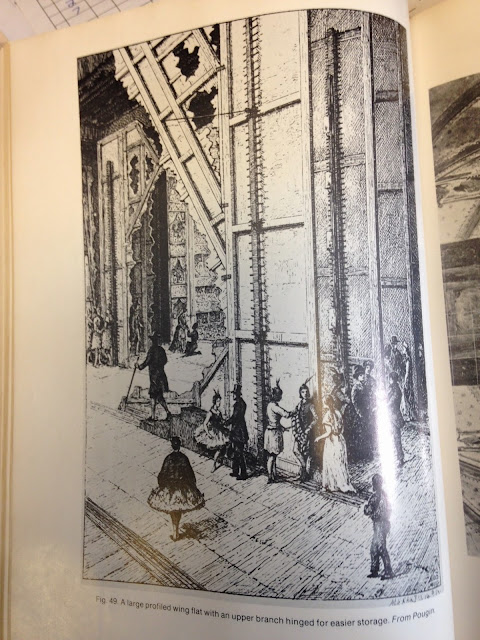
In an article “the New Theatre” published in the New York Times on 1873 (not to be confused with Claude Hagen’s new theatre that occurs 40 years “ish” later) also reference James Schonberg as contributing to designing the stage. The building is being done by architect, Frederick Draper. The proscenium “will be of original form and construction, the plans for it having been designed by Mr. Dion Boucicault, and will be so formed as to act as a sounding board.” The stage is described as having many improvements by Boucicault and Schonberg. The stage is described as 40 squares, each 3’ which can be raised and lowered. These could also be used to create steps. This article describes a patent by Schonberg for supporting and setting the scenery, but also describes traditional scenery (defining it by two types, English and French). The article describes French Stage shifting equipment as a truck beneath the stage with a ladder / frame that the scenery is mounted to. (Pictures below are from French Theatrical Production Nineteenth Century by J P Moynet). The article discusses advantages and disadvantages of this system. They describe the English system as having the scenery supported from above, by “grooves” or “parallel fillets”. This technique is said to be faster than the French system and able to be done in front of the audience. Disadvantages are that everything is square and that grooves must be masked. It also talks about stage screws and braces; obviously we have inherited many of these practices despite European theatrical influences. The article names Mr Flechter and the London Lyceum as advancing a system blending the techniques for shifting scenery, also including Boucicault and Schonberg. The new Lyceum Theatre (in NY) would be built with mechanisms described within the article (too lengthy to quote but freely available on the NY Times Archives Website).
In “Mr. Fechter’s Theatre”, published in the New York Times Jan 20, 1873, we see a continuation of the description of the theatre. It has a very elaborate account of the building itself. Included are items that involve fire safety such as doors that swing in both directions. The theatre was outfitted with gas lighting (that could change color and strength). The stage itself moved as well. The theatre includes a second “sounding-board” (proscenium) which moves upstage – downstage by way of stage machinery. The scenery is lifted from traps “upon what are termed parallel boats, are then attached to the stage, which, with the scenery upon it, can be moved completely out of sight of the audience.” Credit to the system was given to James Schonberg who was a stage manager at the Wallack’s Theatre, and the article states that he patented the system. W. Lester, a machinist, built the system. Absent from this account is Dion Boucicault’s contributions. Under the stage, the area is described as “a perfect labyrinth of cranks, wheels, parallel boats and other mysteries, all worked by hand”. The workshops are also under the stage, while the scenic painter’s gallery is behind the stage, in use by painters Hosford and Laran.
Further New York Times articles indicate that James Schonberg was also a playwright.
His patent can be seen online as well: US 123735
As a side note, I have come across many references to technicians referred to bay their last name only (though very politely). This makes tracing these names more difficult, if not impossible, at least with the fairly searches that I am doing within this research. I assume that they have shorted the names to save space, or because they considered the first names unimportant and not that there was an assumption that they were so well known that first names were not needed. I say this because many names that I am more familiar with are fully spelled out.



In “Mr. Fechter’s Theatre”, published in the New York Times Jan 20, 1873, we see a continuation of the description of the theatre. It has a very elaborate account of the building itself. Included are items that involve fire safety such as doors that swing in both directions. The theatre was outfitted with gas lighting (that could change color and strength). The stage itself moved as well. The theatre includes a second “sounding-board” (proscenium) which moves upstage – downstage by way of stage machinery. The scenery is lifted from traps “upon what are termed parallel boats, are then attached to the stage, which, with the scenery upon it, can be moved completely out of sight of the audience.” Credit to the system was given to James Schonberg who was a stage manager at the Wallack’s Theatre, and the article states that he patented the system. W. Lester, a machinist, built the system. Absent from this account is Dion Boucicault’s contributions. Under the stage, the area is described as “a perfect labyrinth of cranks, wheels, parallel boats and other mysteries, all worked by hand”. The workshops are also under the stage, while the scenic painter’s gallery is behind the stage, in use by painters Hosford and Laran.
Further New York Times articles indicate that James Schonberg was also a playwright.
His patent can be seen online as well: US 123735
As a side note, I have come across many references to technicians referred to bay their last name only (though very politely). This makes tracing these names more difficult, if not impossible, at least with the fairly searches that I am doing within this research. I assume that they have shorted the names to save space, or because they considered the first names unimportant and not that there was an assumption that they were so well known that first names were not needed. I say this because many names that I am more familiar with are fully spelled out.


Sunday, February 9, 2014
Project Resource for Teaching Tools
I was browsing the internet looking for ideas for a project for my nephews to make over the summer when they visit. Complicated enough that a 13 year old would be interested, simple enough that I could help the younger kids in the neighborhood through it as well. I started off thinking about either a pine car derby or CO2 cars. Then I found Kelvin Educational. This sight has good prices on pieces if I do decide on cars,, but they have a lot of other cool things too, many geared towards classroom use. Bridges, cranes, catapults, hydraulics, robots, they have a bit of it all. Certainly a resource to use when thinking about how to teach concepts of engineering within the classroom.
Monday, August 22, 2011
Fabric, Webbing & Fasteners
Looking through the current issue of Specialty Fabrics Magazine, there were a couple vendors that carried equipment that could be put to use theatrically. The first, Cole Tech carries an assortment of Marine rigging hardware, mostly rings, webbing adjusters, and hooks. While they don't have alot of a selection, I think that it would be an interesting or helpful practice to use triangle "rings" instead of normal "D" rings. This is one of the good points of the "delta" hangers that Mutual hardware sells.
The second, Lowy, carries webbing, a variety of fasteners, hot cutters, and robes, including bungee cord.
The second, Lowy, carries webbing, a variety of fasteners, hot cutters, and robes, including bungee cord.
Monday, December 27, 2010
The Development of Scenic Spectacle
Occasionally, I come across something, a site, technique or product that I know to be really great, and realize that I haven't passed it on yet, here on my blog. As I try to use this both to help others from reinventing wheels that have previously been invented and improved upon, and as a depository of ideas, I need to pass on Dr. Frank Mohler's site The Development of Scenic Spectacle. I have been referring to the site on and off for years after discovering it in grad school doing research. On the site there are animated models of how historic rigging / automation worked from the 16th, 17th, and 18th century. The site also has a great bibliography. Check it out - you won't be disappointed.
Friday, January 22, 2010
In-House Production
Today I was doing a little work involving mounting an I-beam & Trolley to truss, and was doing some looking around for hardware and came across this site. In-House Production has a few training videos, a blog and some other information about rigging that is worth a look.
Tuesday, March 31, 2009
Rigging - Hangers
Mutual Hardware has a product that they manufacture that is fantastic for rigging. Once you use the delta hanger (with a delta link) instead of the normal D-ring style, you will never want to go back. I know some companies form the cable eyes around the d-ring, but then you have to cut it off to salvage the ring, or you need to add in a shackle. With the link these hangers are easily reusable without the additional cost of a shackle. They are load-rated. You can check them out here.


Monday, March 30, 2009
Roll Drop / Olio Rigging
I had a request for a manual roll drop from a client today, and I started to think about alternative ways to build one. I decided to do a search and found a few sources online for the traditional rigging techniques. I will make a distinction though - there are labeling issues. A roll drop tends to roll down - and only has enough weight in the bottom so it hangs / moves correctly. An olio drop, traditionally, has the roll at the bottom and its top is fixed. On olio drops you see the rigging mechanism (rope)on each side as the rope coils around the tube as it goes up and down.
Check out the links for more information:
How can I make an Olio Drop
Rigging a Roll Drop
Stage Rigging 101 This sight doesn't tell you much about rigging a drop, but it does have a nice overview of the subject.
Check out the links for more information:
How can I make an Olio Drop
Rigging a Roll Drop
Stage Rigging 101 This sight doesn't tell you much about rigging a drop, but it does have a nice overview of the subject.
Monday, March 23, 2009
USITT Notes
OnThere are no bad ideas, the recent entry asks about what is missing on the USITT expo floor. I think I would ad to his list the Hossfeld people, and perhaps hardware / caster suppliers.
The Daily AutoCAD blog had a tutorial for getting section views from 3-D solids, relating the the 3D Studio Max comments I made the other day.
The track that I liked from Thern can be seen here:
http://www.hallstage.com/uploads/documents/T60%20Leaflet.pdf
http://www.hallstage.com/uploads/documents/T60%20Details.pdf
http://www.hallstage.com/product/productlist.asp?catid=4
http://www.hallstage.com/uploads/documents/T70%20Leaflet.pdf
http://www.hallstage.com/uploads/documents/T70%20Details.pdf
I like the built-in alignment system.
The Daily AutoCAD blog had a tutorial for getting section views from 3-D solids, relating the the 3D Studio Max comments I made the other day.
The track that I liked from Thern can be seen here:
http://www.hallstage.com/uploads/documents/T60%20Leaflet.pdf
http://www.hallstage.com/uploads/documents/T60%20Details.pdf
http://www.hallstage.com/product/productlist.asp?catid=4
http://www.hallstage.com/uploads/documents/T70%20Leaflet.pdf
http://www.hallstage.com/uploads/documents/T70%20Details.pdf
I like the built-in alignment system.
Sunday, March 22, 2009
USITT - Saturday

Today's excitement on the floor was Foy, ZFX, and Hall Associates flying people. The above picture is the ZFX rig.
Besides spending a few remaining minutes on the show floor, I saw two sessions today. The first was "Technical Design / Direction - In a Disney Theme Park". Chuck Davis gave an interesting view into the scale and process that goes into creating a major park element. I think what was interesting to me was the degree that they come up with an idea, but they have to internally sell the idea to get funding. Since these projects are worth millions, they spend hundreds of thousands of dollars proving the ideas and methods as they proceed. While we certainly don't produce on the scope of Disney, we also often don't invest in enough time planning and determining if something will work before we are well into the process and committed. I think sometimes we would be well served to remember that spending some preliminary funding to investigate a technique before commitment allows for a smoother process, and money saved in the long run.
Next I went to "Draw Me a Picture: Collaborative Problem Solving through Digital Storyboarding". It was chaired by Robert W. Johnson, and the presenters included Gregory K. Bell, and Greg Stump. The session was an interesting view on how technology is improving and growing as a communication tool. Some of the packages that we receive are fully storyboarded, and 3-D rendered, and I suspect that much of that is to sell the product, not really for building, but it helps on the build side as well. In 3D Studio Max they showed off the section tool to get 2-D sections from a complex 3-d shape. That is a handy feature, but not enough for me to buy the program. They also talked about modeling a complex 3-D shape (a bust for Mozart) and then doing a section about every 1/2, which was then used to machine the shape. After that they did fine tooling, and made a mold from the piece to make multiples. As great as cnc machining is, I take from this, that it still isn't to the place where it is easier to simply machine something than it is to make a mold and cast duplicated. (Which for complex 3-D items is true where I work as well). The other design they talked about was a structure used for Jesus Christ Superstar where the cross was on a cantilevered beam, and after being crucified, the cross slid back, leaving Jesus hanging against a black background. The set was cool, and the 3-D software helped them animate the sequence to make sure that everyone knew what they were looking for and to help start the technical discussions. The middle part of the session was about how they accomplished the effect. The last part largely revolved around SketchUp. having heard and seen alot of the program, I fully agree to its usefulness. The presenter showed using it to define the structure, and building off of drawings created by SketchUp. This is certainly intriguing, and though he said the tolerances were much more precise than what we need in theatre, I still am suspect. For instance I know some people who routinely use it for preliminary design development, but when it comes time to build, the tolerances are usually +/- inches - far too big to use for build.
The last session of the conference for me was "Tricks of the Stage - Stage Magic". It was nice to see so many prop related sessions this year, and I enjoyed this one as well. John M. Lavarnway chaired the session and went through, with input from his other panelists, how to put together the effect. He stressed defining the effect, research, covering liability concerns, reliability concerns, and how to work with the Actors with the trick. They then showed a variety of effects such as using solenoids for Blithe Spirit, the throwing knife trick, and turning wine into water.
By the time that session let out the expo had been closed for about 45 minutes or so, and the strike was quickly proceeding.
Thursday, March 12, 2009
Cable Assembly Measurements
I am planning on ordering a few stainless steel cable assemblies, and I wanted to make sure that I was specifying the lengths correctly. I found that Loos & Co had a handy reference picture. They also have a stretch calculator.


Monday, February 2, 2009
Sure Grip Rope
J. R. Clancy has recieved a patent on their new rope designed to show wear. When the rope needs to be replaces, the users will be able to see red fibers, left by a red thread woven into the rope. The rope is availble in white or red.
More information:
Lights and Sound America
Stagespot w/ PricingJ. R. Clancy
More information:
Lights and Sound America
Stagespot w/ PricingJ. R. Clancy
Tuesday, November 4, 2008
Rigging Information
I am in the process of buying a dozen or so pre-made wire rope cable assemblies made with stainless steel wire rope and have been coming across a few good resources to pass along.
The first link come from the UK. Of interest to me in the first link are turnbuckles that have a swivel in the end (look at page 17). One their site they also say that the breaking strength of the forks are determined by the clevis pin and the threads. Obvious, but I'm not sure that I have seen it stated so succinctly. In the second link they have a round eye with a plate and a threaded stud which looks like it would be a good rigging connection. They also have them with a nut if you need to bolt from the other direction.
http://www.southernrigging.co.uk/bluewave/marine/index-marine92b0.html?ID=260&PID=46
http://www.southernrigging.co.uk/other.htm
The next link is a rigging book from the US Coast Guard:
http://www.uscg.mil/directives/cim/16000-16999/CIM_16500_21.pdf
The end certainly has stuff that isn't very useful, but some of the beginning sections are full of useful references.
http://loosco.com/index.htm Includes a glossary, length tolerances and stretch and other resources.
http://www.sapsis-rigging.com/index.html
Sapsis Rigging, need I say more!
http://www.jrclancy.com/about_leader.html
JR Clancy
http://dbs.idaho.gov/safety_code/091.html
Idaho Rigging Standards
http://gear.sherrilltree.com/iwwidb.pvx?;multi_item_submit
You can get a clew.
http://www.thecrosbygroup.com/
Crosby. The training section is a must visit site.
http://www.savacable.com/
http://www.decorcable.com/Index.aspx Decorative cables
http://wescovan.com/
http://www.samsonrope.com/
http://www.caldwellinc.com/
The first link come from the UK. Of interest to me in the first link are turnbuckles that have a swivel in the end (look at page 17). One their site they also say that the breaking strength of the forks are determined by the clevis pin and the threads. Obvious, but I'm not sure that I have seen it stated so succinctly. In the second link they have a round eye with a plate and a threaded stud which looks like it would be a good rigging connection. They also have them with a nut if you need to bolt from the other direction.
http://www.southernrigging.co.uk/bluewave/marine/index-marine92b0.html?ID=260&PID=46
http://www.southernrigging.co.uk/other.htm
The next link is a rigging book from the US Coast Guard:
http://www.uscg.mil/directives/cim/16000-16999/CIM_16500_21.pdf
The end certainly has stuff that isn't very useful, but some of the beginning sections are full of useful references.
http://loosco.com/index.htm Includes a glossary, length tolerances and stretch and other resources.
http://www.sapsis-rigging.com/index.html
Sapsis Rigging, need I say more!
http://www.jrclancy.com/about_leader.html
JR Clancy
http://dbs.idaho.gov/safety_code/091.html
Idaho Rigging Standards
http://gear.sherrilltree.com/iwwidb.pvx?;multi_item_submit
You can get a clew.
http://www.thecrosbygroup.com/
Crosby. The training section is a must visit site.
http://www.savacable.com/
http://www.decorcable.com/Index.aspx Decorative cables
http://wescovan.com/
http://www.samsonrope.com/
http://www.caldwellinc.com/
Thursday, September 25, 2008
Canopy Article
The September edition of Stage Directions is out and includes an article of mine in the answer box section! You can also check it out on their website at:
http://stage-directions.com/index.php?option=com_content&task=view&id=1044&Itemid=39
http://stage-directions.com/index.php?option=com_content&task=view&id=1044&Itemid=39
Thursday, July 31, 2008
Photos
Dave Vick, assistant carpenter / rigger for the tour of "A Chorus Line" has posted a photo album online chronicling his adventures. Its a definite must see!
http://rigger.smugmug.com/gallery/4638345_cmt5V#292645103_cFZg4
http://rigger.smugmug.com/gallery/4638345_cmt5V#292645103_cFZg4
Grapple
Today I stumbled upon a Grapple:
http://www.tmb.com/Pdf/GrappleApps-web.pdf
They are for use with truss, primarily joining truss pieces together at perpendicular angles, though they have a variety of other uses.
However, it seems that they could also be used in some situations with pipe as well.
Take a look!
http://www.tmb.com/Pdf/GrappleApps-web.pdf
They are for use with truss, primarily joining truss pieces together at perpendicular angles, though they have a variety of other uses.
However, it seems that they could also be used in some situations with pipe as well.
Take a look!
Friday, July 25, 2008
Rigging
The relationship between sailing and rigging is very clear, and rooted in history. However, I think that it is sometimes forgotten that sailing and boat rigging have undergone advances in technology that is still very useful in theatre.
The series of links below illustrate a variety of sheaves that can be mounted from a stanchion (or in our case, pipe). While a piece could certainly be made by most shops that would do essentially the same thing, I thought the choices where interesting, and at good prices. I know that there have been pieces I have rigged in the past where being able to directly connect the sheave to the pipe, instead of making a bracket would have been convenient.
http://www.defender.com/product.jsp?=111877896314167&id=107678
http://www.furling.com/accessories.html
http://garhauermarine.com/catalog_process.cfm?cid=57
http://tinyurl.com/6z4v4b
The series of links below illustrate a variety of sheaves that can be mounted from a stanchion (or in our case, pipe). While a piece could certainly be made by most shops that would do essentially the same thing, I thought the choices where interesting, and at good prices. I know that there have been pieces I have rigged in the past where being able to directly connect the sheave to the pipe, instead of making a bracket would have been convenient.
http://www.defender.com/product.jsp?=111877896314167&id=107678
http://www.furling.com/accessories.html
http://garhauermarine.com/catalog_process.cfm?cid=57
http://tinyurl.com/6z4v4b
Tuesday, July 15, 2008
Rigging Manual
Texas Scenic Company has a variety of information regarding rigging on their site - one of which is a counterweight rigging manual:
http://www.texasscenic.com/rigmanual.pdf
http://www.texasscenic.com/rigmanual.pdf
Monday, June 16, 2008
Rigid Rigging Point
While working on my last project I became aware of a new rigging component that I have not used before!

You can find it at: http://www.thelightsource.com/products/50/view
It has a safe vertical working load of 1100 pounds. While it doesn't allow for vertical adjustment in the same manner that a chain would, yet I can think of a variety of situations where it would be very useful.
You can find it at: http://www.thelightsource.com/products/50/view
It has a safe vertical working load of 1100 pounds. While it doesn't allow for vertical adjustment in the same manner that a chain would, yet I can think of a variety of situations where it would be very useful.
Thursday, May 1, 2008
Technora Rope
One of the jobs I recently bid specified technora rope. Below is a picture of a sample. It has a few interesting characteristics. The strength of the rope is amazing. In the picture you can see that the rope looks angular. Once the rope is under load it becomes more circular in shape. This feature makes me wonder how the rope would react to knots, going over sheaves and other conditions typical in our environment. My concern is that if different loading conditions changed the shape of the rope, would it effect the capacity of the rope. You can go here for more information

Subscribe to:
Posts (Atom)


