While obviously useful for its normal use for crates, I would be curious to see if it would be a useful piece of hardware for scenery in rep theatre - though obviously it would be limited to 90 degree corners.
Showing posts with label Engineering. Show all posts
Showing posts with label Engineering. Show all posts
Friday, June 3, 2016
Klimp Fasteners
A job recently came in and the crates used Klimp fasteners. They "clip" into place and secure the crate without the use of bolts. The package we received to do work on was about 5 years old, and had seen international travel, so they had help up pretty well as an alternative methodology for crate construction.


Monday, February 29, 2016
Roll Drops
The other day I was thinking about roll drops - in particular a job I bid a couple years ago that used roller shades back to back for a TV studio. The material on the shades was a print on blackout material - but they also used them for light boxes, obviously with a different material for the print.
They were using these rollers from Denny mfg. They carry 12' long drops, and are pretty economical.
While looking for the information on Denny Manufacturing I also ran across a few other companies that produce equipment that could be used in situations like these.
polarshade.com
Titan Patio Drop Shade can do 20' wide by 18' tall
qmotionshades.com
mariak.com
draperinc.com
rollertrol.com
They were using these rollers from Denny mfg. They carry 12' long drops, and are pretty economical.
While looking for the information on Denny Manufacturing I also ran across a few other companies that produce equipment that could be used in situations like these.
polarshade.com
Titan Patio Drop Shade can do 20' wide by 18' tall
qmotionshades.com
mariak.com
draperinc.com
rollertrol.com
Thursday, October 2, 2014
Technology Training Free Resources
I came across IDC Technologies September 2014's newsletter technical download page, and thought that it is good information to keep as well as to pass on. The page offers a number of links ranging from project management to mechanical Design Concepts for Non-Mechanical Engineers to a train the trainer document. They also have webinars available, that would be worth looking into.
Saturday, July 5, 2014
Anticipating Questions and Problems
Anticipating questions and potential problems is a basic
step in technical direction and in project management, but one that I often see
skipped when the timeline gets tight.
I read once that 70% of project related questions could be
anticipated and prepared for – things like schedule, facility information
(dock, door / elevator sizes, etc), contact information for onsite, and so
forth are easy to anticipate and this information should be collected
early. Asking these questions in advance
allow the PM or TD to be prepared when the project is discussed with the crew,
since the PM/TD will already be able to answer the crews questions or will
present the information as part of the discussion.
While I think that collecting this information in the beginning,
it seems like the step often gets skipped when the project is on a fast
track. I also see situations where a
TD/PM is somewhat reactive to information instead of proactive. I know that personally I often avoid any sort
of intake forms when I am starting a project, yet these have usually been
created for a reason, often reminding the user of a variety of questions to ask
and necessary information. Often I find
that clients don’t seem to have all of the necessary information either, but
asking the question early at least spurs them into collecting the necessary
information. And using forms shouldn’t
be seen as a weakness, there is often a lot of wasted time collecting
information that could easily be streamlined if the necessary information was
anticipated. Further, potential problems
could be anticipated with information presented early in the process.
Tuesday, March 25, 2014
New Stage Machinery in 1873
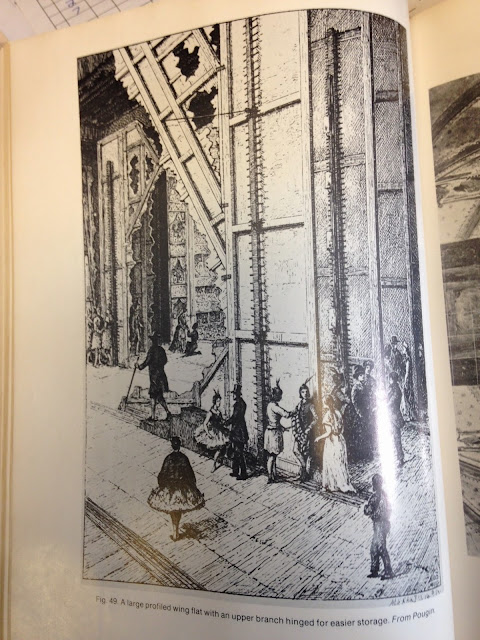
In an article “the New Theatre” published in the New York Times on 1873 (not to be confused with Claude Hagen’s new theatre that occurs 40 years “ish” later) also reference James Schonberg as contributing to designing the stage. The building is being done by architect, Frederick Draper. The proscenium “will be of original form and construction, the plans for it having been designed by Mr. Dion Boucicault, and will be so formed as to act as a sounding board.” The stage is described as having many improvements by Boucicault and Schonberg. The stage is described as 40 squares, each 3’ which can be raised and lowered. These could also be used to create steps. This article describes a patent by Schonberg for supporting and setting the scenery, but also describes traditional scenery (defining it by two types, English and French). The article describes French Stage shifting equipment as a truck beneath the stage with a ladder / frame that the scenery is mounted to. (Pictures below are from French Theatrical Production Nineteenth Century by J P Moynet). The article discusses advantages and disadvantages of this system. They describe the English system as having the scenery supported from above, by “grooves” or “parallel fillets”. This technique is said to be faster than the French system and able to be done in front of the audience. Disadvantages are that everything is square and that grooves must be masked. It also talks about stage screws and braces; obviously we have inherited many of these practices despite European theatrical influences. The article names Mr Flechter and the London Lyceum as advancing a system blending the techniques for shifting scenery, also including Boucicault and Schonberg. The new Lyceum Theatre (in NY) would be built with mechanisms described within the article (too lengthy to quote but freely available on the NY Times Archives Website).
In “Mr. Fechter’s Theatre”, published in the New York Times Jan 20, 1873, we see a continuation of the description of the theatre. It has a very elaborate account of the building itself. Included are items that involve fire safety such as doors that swing in both directions. The theatre was outfitted with gas lighting (that could change color and strength). The stage itself moved as well. The theatre includes a second “sounding-board” (proscenium) which moves upstage – downstage by way of stage machinery. The scenery is lifted from traps “upon what are termed parallel boats, are then attached to the stage, which, with the scenery upon it, can be moved completely out of sight of the audience.” Credit to the system was given to James Schonberg who was a stage manager at the Wallack’s Theatre, and the article states that he patented the system. W. Lester, a machinist, built the system. Absent from this account is Dion Boucicault’s contributions. Under the stage, the area is described as “a perfect labyrinth of cranks, wheels, parallel boats and other mysteries, all worked by hand”. The workshops are also under the stage, while the scenic painter’s gallery is behind the stage, in use by painters Hosford and Laran.
Further New York Times articles indicate that James Schonberg was also a playwright.
His patent can be seen online as well: US 123735
As a side note, I have come across many references to technicians referred to bay their last name only (though very politely). This makes tracing these names more difficult, if not impossible, at least with the fairly searches that I am doing within this research. I assume that they have shorted the names to save space, or because they considered the first names unimportant and not that there was an assumption that they were so well known that first names were not needed. I say this because many names that I am more familiar with are fully spelled out.



In “Mr. Fechter’s Theatre”, published in the New York Times Jan 20, 1873, we see a continuation of the description of the theatre. It has a very elaborate account of the building itself. Included are items that involve fire safety such as doors that swing in both directions. The theatre was outfitted with gas lighting (that could change color and strength). The stage itself moved as well. The theatre includes a second “sounding-board” (proscenium) which moves upstage – downstage by way of stage machinery. The scenery is lifted from traps “upon what are termed parallel boats, are then attached to the stage, which, with the scenery upon it, can be moved completely out of sight of the audience.” Credit to the system was given to James Schonberg who was a stage manager at the Wallack’s Theatre, and the article states that he patented the system. W. Lester, a machinist, built the system. Absent from this account is Dion Boucicault’s contributions. Under the stage, the area is described as “a perfect labyrinth of cranks, wheels, parallel boats and other mysteries, all worked by hand”. The workshops are also under the stage, while the scenic painter’s gallery is behind the stage, in use by painters Hosford and Laran.
Further New York Times articles indicate that James Schonberg was also a playwright.
His patent can be seen online as well: US 123735
As a side note, I have come across many references to technicians referred to bay their last name only (though very politely). This makes tracing these names more difficult, if not impossible, at least with the fairly searches that I am doing within this research. I assume that they have shorted the names to save space, or because they considered the first names unimportant and not that there was an assumption that they were so well known that first names were not needed. I say this because many names that I am more familiar with are fully spelled out.


Tuesday, March 11, 2014
Carl Lautenschlager, Technical Director.
The earliest mention of a “Technical Director” within the New York Times is in an article titled “Conried Tells his Plans” published on May 14, 1903. Within the article Conreid (a producer) announces that Carl Lautenschlager will REMAIN with him as TD for work at the Metropolitan Opera House. The article also describes that a new lighting system, counterweight system, stage floor, and costumes will be purchased and installed, and a revolving stage is to be added a year later. These improvements are probably for “Parsifal”.
In a December 20, 1903 article in the New York Times, called “”Parsival,” The Music Drama” outlines the story. It announces the upcoming opening of the show. The article lists Lautenschlager as “Technical Director (in charge of all mechanical and electrical effects)” as part of the cast list. Further, the article indicates that Lautenschlager has rebuilt the stage and “devised” lighting, and claims that he “has no rival in his own field in Europe.” It is also interesting to note that “including the electricians, property men, stage hands, supernumeraries, and choruses, nearly 300 persons” are involved. While we cannot be certain how many of these people filled a technical role versus being on the stage, it does suggest a vastness of scale to the production.
Several days later, the New York Times, on December 25, 1903, claims “”Parsifal” A Triumph”. This article indicates that “The chief masters of stage craft and of scenic manipulation had been summoned from Germany to superintend and co-ordinate the material factors.” The article also lists Lautenschlager as part of the cast list.
Henry Edward Krehbiel offers information to the end of Carl’s tenure in the USA. In Chapters of Opera, published in 1911, Carl is mentioned as “stage mechanican, or technical director” and it is claimed that despite doing notable work in “Parsifal” he was “hampered by the prevailing conditions” and returned after a year to Germany.
Carl Lautenschlage also is mentioned within The Election, Volume 34, on March 29, 1895. Here he is described as a “great Bavarian stage machinist”, and is working on London on a new ballet. He is also credited as being “well known in theatrical circles as electrician to the Court Theatre of Bavaria, and his efforts to introduce the use of electricity in connection with the machinery of the stage have been crowned with considerable success.” It would seem as though this would indicate that he is the father of theatre automation as well as perhaps America’s for Technical Director. It is clear from what I am reading about Lautenschlage, Hagen, and others that they were generally machinists, involved in lighting, as well as involved with installing large scale stage mechanics for the stage, not just for an individual production.
Revolving Architecture: A History of Buildings that Rotate, Swivel, and Pivot by Chad Randi, states that the first patent for a rotating stage was in 1883 by Charles Needham, but was not built. The Fifth Avenue Theatre evidently had a master machinest that also proposed a turntable. In Germany, Karl Lautensschlager was working at the Mucich Court and Residence Theatre and installed, in 1896, the first permanent rotating stage in the Western part of the globe. He was also looking at lifts and traps, similar to what Claude Hagen would later install in the New Theatre in NY. Further, Carl is also credited with installing 4 of these in major cities throughout Europe. This author claims that the first rotating stage in America was at Ye Liberty Playhouse in Oakland, Ca in 1903. Harry Bishop is listed as the “manager”, who may have been influenced by Japanese Kabuki stages. It is clear from the description that this was manually operated by stagehands. That Lautenschlager was first is also supported by The Japanese Theatre: From Shamanistic Ritual to Contemporary Pluralism by Benito Ortolani.
He is also mentioned in Theatre Technology by George Izenour. Izenour is about to produce quite a bit about his background. Carl was born Arpil 11, 1843. After he father died, he mother remarried to a man that was a stage inspector. As he started working he originally studied under Carl Brandt, eventually moving to Munich and working there for 22 years. While there, he was sent to Paris to study an electrical exhibition there. Upon his return to Munich he installed electric lighting. Working with Jocza Savits they reinvented the way Shakespear was performed. He is also listed as working with Ernst Possart for the development of the rotating stage. Izenour states that he retired in 1902 (though we know that he came to the US), and that he died on June 30, 1906. It seems as though once he went back to Germany after his American tenure, he did not return to the stage.
He is also mentioned in Wagner Nights: An American History by Joseph Horowitz, Richard Struss: A Chronical of the Early Years, 1864-1898 by Will Schuh (credited with installing a revolving stage in 1896 in the Residenztheatre), Richard Wagner and His World by Thomas S. Grey (a photo is available of Carl here), The Dramatic Touch of Difference: Theatre, Own and Foreign edited by Erika Fischer-Lichte, Josephine Riley, Michael Gissensehrer (though this is a fleeting reference), The Development of methods for Flying Scenery on the English Stage, 1800-1960 by Susan Stockbridge, a supplement written by Lautenschlager in Scientific American Supplement, no 1541 (July 15, 1905), Early Uses of Electricity for the Theatre:1880-1900 by Walter Kenneth Waters Jr.
Wikipedia also offers the following bibliography:
The American Architect and Building News. Volume 53. Boston: American. Architect and Building News Co, 1896.
Ackermann, Friedrich Adolf. The Oberammergau Passion Play, 1890. Fifth Edition. Munich: Friedrich Adolf Ackermann, 1890.
Fuerst, Walter René and Hume, Samuel J. Twentieth-Century Stage Decoration. Volume 1. New York: Dover Publications, 1967.
Hoffer, Charles. Music Listening Today. Fourth Edition. Boston: Schirmer Cengage Learning, 2009.
Izenour, George C. Theater Technology. New Haven: Yale University Press, 1996.
MacGowan, Kenneth. The Theatre of Tomorrow. New York: Boni and Liveright, 1921. Print.
Ortolano, Benito. The Japanese theatre: from shamanistic ritual to contemporary pluralism. Princeton: Princeton University Press, 1990.
Randl, Chad. Revolving architecture. New York: Princeton Architectural Press, 2008. Print.
Sachs, Edwin. Modern Theatre Stages. New York: Engineering, 1897. Print.
Vermette, Margaret. The Musical World of Boublil and Schönberg: The Creators of Les Misérables, Miss Saigon, Martin *Guerre, and The Pirate Queen. New York: Applause Theatre & Cinema Books, 2006.
Williams, Simon. Shakespeare on the German stage: 1586–1914. Volume 1. Cambridge: Cambridge University Press, 1990.
WPG, . The Revolving Stage at the Munich Royal Residential and Court Theatre. New York: American Architect and Architecture, 1896. Print.
It also seems that more would be available if I was able to do additional research in German.
In a December 20, 1903 article in the New York Times, called “”Parsival,” The Music Drama” outlines the story. It announces the upcoming opening of the show. The article lists Lautenschlager as “Technical Director (in charge of all mechanical and electrical effects)” as part of the cast list. Further, the article indicates that Lautenschlager has rebuilt the stage and “devised” lighting, and claims that he “has no rival in his own field in Europe.” It is also interesting to note that “including the electricians, property men, stage hands, supernumeraries, and choruses, nearly 300 persons” are involved. While we cannot be certain how many of these people filled a technical role versus being on the stage, it does suggest a vastness of scale to the production.
Several days later, the New York Times, on December 25, 1903, claims “”Parsifal” A Triumph”. This article indicates that “The chief masters of stage craft and of scenic manipulation had been summoned from Germany to superintend and co-ordinate the material factors.” The article also lists Lautenschlager as part of the cast list.
Henry Edward Krehbiel offers information to the end of Carl’s tenure in the USA. In Chapters of Opera, published in 1911, Carl is mentioned as “stage mechanican, or technical director” and it is claimed that despite doing notable work in “Parsifal” he was “hampered by the prevailing conditions” and returned after a year to Germany.
Carl Lautenschlage also is mentioned within The Election, Volume 34, on March 29, 1895. Here he is described as a “great Bavarian stage machinist”, and is working on London on a new ballet. He is also credited as being “well known in theatrical circles as electrician to the Court Theatre of Bavaria, and his efforts to introduce the use of electricity in connection with the machinery of the stage have been crowned with considerable success.” It would seem as though this would indicate that he is the father of theatre automation as well as perhaps America’s for Technical Director. It is clear from what I am reading about Lautenschlage, Hagen, and others that they were generally machinists, involved in lighting, as well as involved with installing large scale stage mechanics for the stage, not just for an individual production.
Revolving Architecture: A History of Buildings that Rotate, Swivel, and Pivot by Chad Randi, states that the first patent for a rotating stage was in 1883 by Charles Needham, but was not built. The Fifth Avenue Theatre evidently had a master machinest that also proposed a turntable. In Germany, Karl Lautensschlager was working at the Mucich Court and Residence Theatre and installed, in 1896, the first permanent rotating stage in the Western part of the globe. He was also looking at lifts and traps, similar to what Claude Hagen would later install in the New Theatre in NY. Further, Carl is also credited with installing 4 of these in major cities throughout Europe. This author claims that the first rotating stage in America was at Ye Liberty Playhouse in Oakland, Ca in 1903. Harry Bishop is listed as the “manager”, who may have been influenced by Japanese Kabuki stages. It is clear from the description that this was manually operated by stagehands. That Lautenschlager was first is also supported by The Japanese Theatre: From Shamanistic Ritual to Contemporary Pluralism by Benito Ortolani.
He is also mentioned in Theatre Technology by George Izenour. Izenour is about to produce quite a bit about his background. Carl was born Arpil 11, 1843. After he father died, he mother remarried to a man that was a stage inspector. As he started working he originally studied under Carl Brandt, eventually moving to Munich and working there for 22 years. While there, he was sent to Paris to study an electrical exhibition there. Upon his return to Munich he installed electric lighting. Working with Jocza Savits they reinvented the way Shakespear was performed. He is also listed as working with Ernst Possart for the development of the rotating stage. Izenour states that he retired in 1902 (though we know that he came to the US), and that he died on June 30, 1906. It seems as though once he went back to Germany after his American tenure, he did not return to the stage.
He is also mentioned in Wagner Nights: An American History by Joseph Horowitz, Richard Struss: A Chronical of the Early Years, 1864-1898 by Will Schuh (credited with installing a revolving stage in 1896 in the Residenztheatre), Richard Wagner and His World by Thomas S. Grey (a photo is available of Carl here), The Dramatic Touch of Difference: Theatre, Own and Foreign edited by Erika Fischer-Lichte, Josephine Riley, Michael Gissensehrer (though this is a fleeting reference), The Development of methods for Flying Scenery on the English Stage, 1800-1960 by Susan Stockbridge, a supplement written by Lautenschlager in Scientific American Supplement, no 1541 (July 15, 1905), Early Uses of Electricity for the Theatre:1880-1900 by Walter Kenneth Waters Jr.
Wikipedia also offers the following bibliography:
The American Architect and Building News. Volume 53. Boston: American. Architect and Building News Co, 1896.
Ackermann, Friedrich Adolf. The Oberammergau Passion Play, 1890. Fifth Edition. Munich: Friedrich Adolf Ackermann, 1890.
Fuerst, Walter René and Hume, Samuel J. Twentieth-Century Stage Decoration. Volume 1. New York: Dover Publications, 1967.
Hoffer, Charles. Music Listening Today. Fourth Edition. Boston: Schirmer Cengage Learning, 2009.
Izenour, George C. Theater Technology. New Haven: Yale University Press, 1996.
MacGowan, Kenneth. The Theatre of Tomorrow. New York: Boni and Liveright, 1921. Print.
Ortolano, Benito. The Japanese theatre: from shamanistic ritual to contemporary pluralism. Princeton: Princeton University Press, 1990.
Randl, Chad. Revolving architecture. New York: Princeton Architectural Press, 2008. Print.
Sachs, Edwin. Modern Theatre Stages. New York: Engineering, 1897. Print.
Vermette, Margaret. The Musical World of Boublil and Schönberg: The Creators of Les Misérables, Miss Saigon, Martin *Guerre, and The Pirate Queen. New York: Applause Theatre & Cinema Books, 2006.
Williams, Simon. Shakespeare on the German stage: 1586–1914. Volume 1. Cambridge: Cambridge University Press, 1990.
WPG, . The Revolving Stage at the Munich Royal Residential and Court Theatre. New York: American Architect and Architecture, 1896. Print.
It also seems that more would be available if I was able to do additional research in German.
Wednesday, February 19, 2014
Fosshape & Wonderflex
For a theatrical production that came through, we were tasked with doing a statue. Instead of carving the body and clothes we used Fosshape. It’s a material that can be sewn or glued, and can be shaped with steam or heat, and when the material is cool it maintains its shape. The material can shrink up t 30% though, so allow for that when using the product. Below are a couple of photos from the shop showing the piece we built.
The same company can has a product called Wonderflex, which would work better in situations where you would typically use Fiberglas, carved foam, or paper mache. It is similar to Celastic, but celastic requires immersion in solvents to become moldable, and Wonderflex uses heat instead. For more information on the history of Celastic & props check out Prop Agenda.


The same company can has a product called Wonderflex, which would work better in situations where you would typically use Fiberglas, carved foam, or paper mache. It is similar to Celastic, but celastic requires immersion in solvents to become moldable, and Wonderflex uses heat instead. For more information on the history of Celastic & props check out Prop Agenda.


Sunday, February 9, 2014
Project Resource for Teaching Tools
I was browsing the internet looking for ideas for a project for my nephews to make over the summer when they visit. Complicated enough that a 13 year old would be interested, simple enough that I could help the younger kids in the neighborhood through it as well. I started off thinking about either a pine car derby or CO2 cars. Then I found Kelvin Educational. This sight has good prices on pieces if I do decide on cars,, but they have a lot of other cool things too, many geared towards classroom use. Bridges, cranes, catapults, hydraulics, robots, they have a bit of it all. Certainly a resource to use when thinking about how to teach concepts of engineering within the classroom.
Wednesday, October 2, 2013
Bed Rail Hangers
I ran across some of these bed rail hangers in the shop today. We often use Z-clip or french cleats to hang things, but I could easily see where these would be useful, particularly on a small item (think prop) or on rails as designed.
Tuesday, June 1, 2010
Prototype This
Over the holiday weekend, in the midst of doing a variety of home projects I watched the 1st (only) season of Prototype This.
The show has a core team of 4 (an electrical engineer, special effects guru, Robotics guy, and a material specialist) that join together to put together some amazing prototypes during a 10 day to 2 week period. Some of the projects they tackled were a mind controlled car that went into neutral when the driver got angry,
a backyard water slide simulator, and a flying life guard, supplying life saving floatation devices to unmanned beaches.
I liked the series, and would recommend it for several reasons.
-They use alot of materials that are used in theatre
-They show alot of different machining technologies, cnc machines, vaccuforming, laser cutting, water jetting
-They use a variety of animation / feedback and other items useful to automation.
-It shows that you can do some amazing things in 2 weeks with the right resources (granted they weren't two 40 hour weeks).
-While cash certainly wasn't an issue (budgets other than time were not even mentioned), using resources wisely was important to meet their goals. They often went to the top of the field for what they were trying to accomplish to get ideas and gain knowledge.
-I think the prototyping process is important, and too often overlooked. And, on top of being important for the realization of a finished product, challenging yourself to do a proof of concept can help you learn a variety of skills even if a finished product is not the end goal.
So if you have a few hours, take a look!
The show has a core team of 4 (an electrical engineer, special effects guru, Robotics guy, and a material specialist) that join together to put together some amazing prototypes during a 10 day to 2 week period. Some of the projects they tackled were a mind controlled car that went into neutral when the driver got angry,
a backyard water slide simulator, and a flying life guard, supplying life saving floatation devices to unmanned beaches.
I liked the series, and would recommend it for several reasons.
-They use alot of materials that are used in theatre
-They show alot of different machining technologies, cnc machines, vaccuforming, laser cutting, water jetting
-They use a variety of animation / feedback and other items useful to automation.
-It shows that you can do some amazing things in 2 weeks with the right resources (granted they weren't two 40 hour weeks).
-While cash certainly wasn't an issue (budgets other than time were not even mentioned), using resources wisely was important to meet their goals. They often went to the top of the field for what they were trying to accomplish to get ideas and gain knowledge.
-I think the prototyping process is important, and too often overlooked. And, on top of being important for the realization of a finished product, challenging yourself to do a proof of concept can help you learn a variety of skills even if a finished product is not the end goal.
So if you have a few hours, take a look!
Thursday, May 6, 2010
Draw Catch
While ordering a few run of the mill door catches, I came across this at McMaster Carr. 
These remote actuation cable latches allow doors to be opened remotely. McMaster describes them as:
These seem like they would be a great low-tech way to do a variety of special effects. I could have used something like that when I did Blithe Spirit a few years back.

These remote actuation cable latches allow doors to be opened remotely. McMaster describes them as:
Operate these latches from a distance—a flexible cable connects the latch and the T-handle. Pull on the handle to retract the round, spring-loaded bolt. Because the cable is flexible, you can bend it around corners and other obstructions. Min. bend radius is 1.5". The recommended maximum amount of total bending is 720° . You have two mounting options: through-hole mount the handle and bolt housing(s) or surface mount them using the included mounting plates. The through-hole mounting size for the handle is 1/2". The through-hole mounting size for the bolt housings is 9/16".
Handles are plastic. Bolts are zinc-plated steel. Mounting plates are 12-ga. steel with a black-oxide finish and require #10 screws (not included). Strike plates are Type 304 stainless steel and require 1/4" screws (not included).
Please specify cable length: 2, 3, 4, 5, 6, 7, 8, or 9 feet.
These seem like they would be a great low-tech way to do a variety of special effects. I could have used something like that when I did Blithe Spirit a few years back.
Monday, January 18, 2010
Games
Its been a while since I have posted any good physics games.
World of Goo is probably my favorite. It is available as wiiware, and is simple and intuitive to operate, but has a pleasing complexity. Generally you move around bits of goo that build towers, cantilevers, bridges, and so forth. Some goo can be reused, other types can catch on fire or be used as fuses.
Tiki Towers is also available on wiiware. The idea is similar to World of Goo - building structures to get to point a to b. Here you are saving the monkeys, and possibly rescuing a few as well. In this game you are using bamboo to build with, and you have a few additional capabilities (reinforcing joints for instance) However, you got a baddie that can catch a segment on fire or turn it into rubber. The game is a little more difficult to control, and a little more challenging than Goo.
If you have a few minutes to burn while you are sitting at the computer check out this site. There are many games to play, straight from your browser.
World of Goo is probably my favorite. It is available as wiiware, and is simple and intuitive to operate, but has a pleasing complexity. Generally you move around bits of goo that build towers, cantilevers, bridges, and so forth. Some goo can be reused, other types can catch on fire or be used as fuses.
Tiki Towers is also available on wiiware. The idea is similar to World of Goo - building structures to get to point a to b. Here you are saving the monkeys, and possibly rescuing a few as well. In this game you are using bamboo to build with, and you have a few additional capabilities (reinforcing joints for instance) However, you got a baddie that can catch a segment on fire or turn it into rubber. The game is a little more difficult to control, and a little more challenging than Goo.
If you have a few minutes to burn while you are sitting at the computer check out this site. There are many games to play, straight from your browser.
Wednesday, January 6, 2010
Alternative Materials
I was looking through an ad for books relating to design and architecture and thought that a couple were worth pointing out.
The first is Materiology by Daniel Kula. It discussed a wide variety of materials as well as how the materials are made. It seemed like a book that would have been perfect when I was taking "Advanced Materials" in grad school.
Another is Materials for Inspirational Design. It offers a view into a variety of materials, uses, and even rough pricing.
Browsing through Amazon offers a variety of books on the subject of materials. Happy browsing!
The first is Materiology by Daniel Kula. It discussed a wide variety of materials as well as how the materials are made. It seemed like a book that would have been perfect when I was taking "Advanced Materials" in grad school.
Another is Materials for Inspirational Design. It offers a view into a variety of materials, uses, and even rough pricing.
Browsing through Amazon offers a variety of books on the subject of materials. Happy browsing!
Friday, October 30, 2009
Engineering
I found a fun (albeit off topic slightly) website today while looking for a local museum. It is the A Sightseers Guide to Engineering. There are a variety of locations listed, and each has a "fun fact" relevant to the attraction. Check it out, perhaps you will find an interesting engineering sight near you.
Thursday, April 30, 2009
"Opera Pins"
I heard a term today in the shop that was new - Opera pins.

They are really just large shop-built lift-off hinges. But they do work nicely.

They are really just large shop-built lift-off hinges. But they do work nicely.
Friday, January 16, 2009
I-Shovel
The past couple of days, with almost a 1' of snow, makes me appreciate the I-Shovel!
http://www.youtube.com/watch?v=NGwcCaz-MpA
I think that I may prefer remote control over the randomness (like the vacuum). While it wouldn't matter to me what path a vacuum cleaner takes, it does matter to me where the pile of now ends up, so having additional control would be appreciated. On the other hand, I wonder if it could be done through sensors - allowing the machine to know a "home" spot that is where the snow should end up.
The other thought I have when I see stuff like this is that theatre technicians should be doing more of this wacky, fun stuff. We have the capability to design and build automated pieces. Perhaps not fully robotic or with as many axis of motion, but experimenting with fun, non-theatre specific ideas can free us from a rigid set of technical design constraints. Plus, having experimented with other technologies we can extrapolate the knowledge gained into more effective technical design solutions.
http://www.youtube.com/watch?v=NGwcCaz-MpA
I think that I may prefer remote control over the randomness (like the vacuum). While it wouldn't matter to me what path a vacuum cleaner takes, it does matter to me where the pile of now ends up, so having additional control would be appreciated. On the other hand, I wonder if it could be done through sensors - allowing the machine to know a "home" spot that is where the snow should end up.
The other thought I have when I see stuff like this is that theatre technicians should be doing more of this wacky, fun stuff. We have the capability to design and build automated pieces. Perhaps not fully robotic or with as many axis of motion, but experimenting with fun, non-theatre specific ideas can free us from a rigid set of technical design constraints. Plus, having experimented with other technologies we can extrapolate the knowledge gained into more effective technical design solutions.
Monday, January 12, 2009
Inkscape
Every year at USITT there is a session on great free / open source software. This should make the list for 2009. I came across it while researching Ponoko -Inkscape is a vector based program similar to adobe illustrator or corel draw.
Thursday, October 9, 2008
Automation Videos
Automation Direct has a variety of learning options on its website. You can find it at:
http://learn.automationdirect.com/
They offer video options for learning about PLC’s, Operator Interfaces, Software, Sensors, Motor Controls, Drive / Motors, and More. The “More” category mostly talks about Automation Direct as a company. They offer a significant amount of content, that is definitely worth checking out!
http://learn.automationdirect.com/
They offer video options for learning about PLC’s, Operator Interfaces, Software, Sensors, Motor Controls, Drive / Motors, and More. The “More” category mostly talks about Automation Direct as a company. They offer a significant amount of content, that is definitely worth checking out!
Tuesday, October 7, 2008
Designing a Ladder Program
Automation Direct’s recent issue of Automation Notebook has an article on designing a Ladder Logic program. It is an interesting article with many good points. It seems as though I have found many basic programs thrown together for one show. This show becomes the basis for the next show, and 10 years later you have the same program that has been altered 40 times, and which has pieces of code no longer valid or integral, because there wasn’t an overall design to the program. While it is often hard to do in the crunch of an individual production, planning for future incarnations of the program when it is first written will make the process easier in the future.
You can take a look at the article at:
http://www.automationnotebook.com/2008_issue_12/techthread_issue12_2008.html
You can take a look at the article at:
http://www.automationnotebook.com/2008_issue_12/techthread_issue12_2008.html
Thursday, September 25, 2008
Canopy Article
The September edition of Stage Directions is out and includes an article of mine in the answer box section! You can also check it out on their website at:
http://stage-directions.com/index.php?option=com_content&task=view&id=1044&Itemid=39
http://stage-directions.com/index.php?option=com_content&task=view&id=1044&Itemid=39
Subscribe to:
Posts (Atom)


