While obviously useful for its normal use for crates, I would be curious to see if it would be a useful piece of hardware for scenery in rep theatre - though obviously it would be limited to 90 degree corners.
Showing posts with label Construction Techniques. Show all posts
Showing posts with label Construction Techniques. Show all posts
Friday, June 3, 2016
Klimp Fasteners
A job recently came in and the crates used Klimp fasteners. They "clip" into place and secure the crate without the use of bolts. The package we received to do work on was about 5 years old, and had seen international travel, so they had help up pretty well as an alternative methodology for crate construction.


Thursday, March 3, 2016
Graphic and Shelving Hanging Systems
One of the items that I see more often in proposals and designs are cable display systems. These can be fairly slick and elegant ways of displaying artwork or graphics, and even merchandise.
Most of the products I have used have come from Arakawa Hanging Systems. There are many options out there though - I have often thought that the next time I do a cover the walls exhibit at USITT that it would be cool to use some of this equipment for the display.
Most of the products I have used have come from Arakawa Hanging Systems. There are many options out there though - I have often thought that the next time I do a cover the walls exhibit at USITT that it would be cool to use some of this equipment for the display.
Monday, December 22, 2014
Museum Men
I have been watching a new show on the History Channel
called “Museum Men”. It’s about a small
custom fabrication (design/build) shop in Florida that builds (at least
primarily) museum exhibits. In some ways
the shop is very much like what I work in, and it is interesting to see how
projects play out in their shop.
On the flip side, the show brings up a number of concerns
(which I am sure is true for every industry that is boiled down to a short
reality tv series).
-Their
timeline from project initiation to installation is about a month. At times it seems as though they have a month
of fabrication time, either way, this isn’t very realistic or practical.
-How
the content is developed seems a little odd.
Perhaps we just aren’t seeing the nuts and bolts here, but the show goes
from a conversation about an element, to going forward full steam. In fact in an episode about building Chuck
Yeager’s Supersonic Jet, they were half way through building the piece when the
owner comes in with goods news and bad news.
Good – they client was spending more money, bad – they jet is too large
and a new piece needs to be built and installed with only the remaining 2 weeks
that had been previously scheduled. Seems
like the client is paying extra to have the jet redone- but this seems like a pretty
major detail that should have been worked out on paper before anything was
built.
-Drawings
and research, as well as what is being delivered seems to be at the owner’s
discretion. Once thy wondered if the jet
could be installed upside down? Even if
the unit is a design build contract, the client should be signing off on something
– including what it will be and look like once it is installed. It seems like they move forward into
construction before they even know all of the details about what they are
constructing.
-Perhaps
a few all night work calls still exists in the industry – but showing the tight
timelines and then encouraging these work practices doesn’t really help clients
understand what we can reasonably accomplish.
-And a
1 hour load in is just a little crazy.
I can only hope that the bigger picture is edited out, but I
am left with a connotation that it shouldn’t take more than a month to design,
build, and install a major piece of exhibition scenery, which is not really
feasible. Now there are a couple of
things to note – they do mention not taking on much additional work – it does
seem like they primarily work on one project at a time. Whether bad or good it is interesting to see
some of their processes and get an inside look!
Thursday, October 2, 2014
Technology Training Free Resources
I came across IDC Technologies September 2014's newsletter technical download page, and thought that it is good information to keep as well as to pass on. The page offers a number of links ranging from project management to mechanical Design Concepts for Non-Mechanical Engineers to a train the trainer document. They also have webinars available, that would be worth looking into.
Tuesday, March 25, 2014
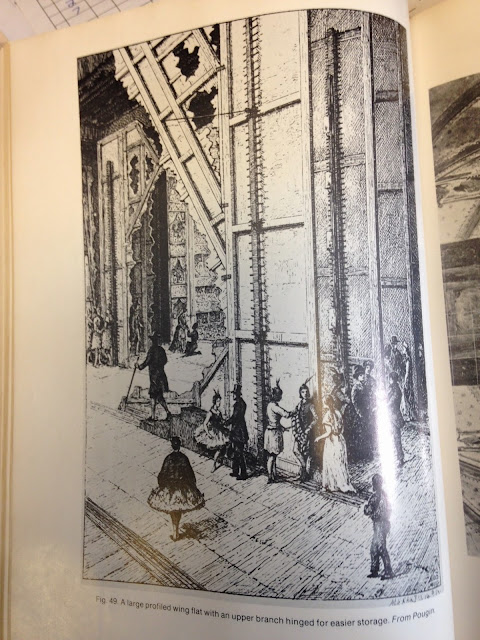
New Stage Machinery in 1873
In an article “the New Theatre” published in the New York Times on 1873 (not to be confused with Claude Hagen’s new theatre that occurs 40 years “ish” later) also reference James Schonberg as contributing to designing the stage. The building is being done by architect, Frederick Draper. The proscenium “will be of original form and construction, the plans for it having been designed by Mr. Dion Boucicault, and will be so formed as to act as a sounding board.” The stage is described as having many improvements by Boucicault and Schonberg. The stage is described as 40 squares, each 3’ which can be raised and lowered. These could also be used to create steps. This article describes a patent by Schonberg for supporting and setting the scenery, but also describes traditional scenery (defining it by two types, English and French). The article describes French Stage shifting equipment as a truck beneath the stage with a ladder / frame that the scenery is mounted to. (Pictures below are from French Theatrical Production Nineteenth Century by J P Moynet). The article discusses advantages and disadvantages of this system. They describe the English system as having the scenery supported from above, by “grooves” or “parallel fillets”. This technique is said to be faster than the French system and able to be done in front of the audience. Disadvantages are that everything is square and that grooves must be masked. It also talks about stage screws and braces; obviously we have inherited many of these practices despite European theatrical influences. The article names Mr Flechter and the London Lyceum as advancing a system blending the techniques for shifting scenery, also including Boucicault and Schonberg. The new Lyceum Theatre (in NY) would be built with mechanisms described within the article (too lengthy to quote but freely available on the NY Times Archives Website).
In “Mr. Fechter’s Theatre”, published in the New York Times Jan 20, 1873, we see a continuation of the description of the theatre. It has a very elaborate account of the building itself. Included are items that involve fire safety such as doors that swing in both directions. The theatre was outfitted with gas lighting (that could change color and strength). The stage itself moved as well. The theatre includes a second “sounding-board” (proscenium) which moves upstage – downstage by way of stage machinery. The scenery is lifted from traps “upon what are termed parallel boats, are then attached to the stage, which, with the scenery upon it, can be moved completely out of sight of the audience.” Credit to the system was given to James Schonberg who was a stage manager at the Wallack’s Theatre, and the article states that he patented the system. W. Lester, a machinist, built the system. Absent from this account is Dion Boucicault’s contributions. Under the stage, the area is described as “a perfect labyrinth of cranks, wheels, parallel boats and other mysteries, all worked by hand”. The workshops are also under the stage, while the scenic painter’s gallery is behind the stage, in use by painters Hosford and Laran.
Further New York Times articles indicate that James Schonberg was also a playwright.
His patent can be seen online as well: US 123735
As a side note, I have come across many references to technicians referred to bay their last name only (though very politely). This makes tracing these names more difficult, if not impossible, at least with the fairly searches that I am doing within this research. I assume that they have shorted the names to save space, or because they considered the first names unimportant and not that there was an assumption that they were so well known that first names were not needed. I say this because many names that I am more familiar with are fully spelled out.



In “Mr. Fechter’s Theatre”, published in the New York Times Jan 20, 1873, we see a continuation of the description of the theatre. It has a very elaborate account of the building itself. Included are items that involve fire safety such as doors that swing in both directions. The theatre was outfitted with gas lighting (that could change color and strength). The stage itself moved as well. The theatre includes a second “sounding-board” (proscenium) which moves upstage – downstage by way of stage machinery. The scenery is lifted from traps “upon what are termed parallel boats, are then attached to the stage, which, with the scenery upon it, can be moved completely out of sight of the audience.” Credit to the system was given to James Schonberg who was a stage manager at the Wallack’s Theatre, and the article states that he patented the system. W. Lester, a machinist, built the system. Absent from this account is Dion Boucicault’s contributions. Under the stage, the area is described as “a perfect labyrinth of cranks, wheels, parallel boats and other mysteries, all worked by hand”. The workshops are also under the stage, while the scenic painter’s gallery is behind the stage, in use by painters Hosford and Laran.
Further New York Times articles indicate that James Schonberg was also a playwright.
His patent can be seen online as well: US 123735
As a side note, I have come across many references to technicians referred to bay their last name only (though very politely). This makes tracing these names more difficult, if not impossible, at least with the fairly searches that I am doing within this research. I assume that they have shorted the names to save space, or because they considered the first names unimportant and not that there was an assumption that they were so well known that first names were not needed. I say this because many names that I am more familiar with are fully spelled out.


Thursday, February 20, 2014
Fabric Shapes and Walls
Many corporate shows seem to be using fabric backdrops with 3-D shapes, with internal lighting. These shapes are also used on show floors as well. While Rosebrand offers some basic shapes and columns, the following three companies are my go to resource when looking for 3D fabric structures.
Pink Inc has flat walls, curves, ripple walls, arches, tunnels, and shapes as well as a few costumes!
Transformit has many of the same products, though they are a little more organic. They can also custom build a piece to your specifications & print on the fabric.
Moss Inc also has a wide variety of shapes, signage and event outdoor tents available.
While many of these things can be built in a shop (either as hard scenery or with frames and fabric) since these places have stock pieces, the engineering and technical development can provide an economic edge to building it yourself.
Pink Inc has flat walls, curves, ripple walls, arches, tunnels, and shapes as well as a few costumes!
Transformit has many of the same products, though they are a little more organic. They can also custom build a piece to your specifications & print on the fabric.
Moss Inc also has a wide variety of shapes, signage and event outdoor tents available.
While many of these things can be built in a shop (either as hard scenery or with frames and fabric) since these places have stock pieces, the engineering and technical development can provide an economic edge to building it yourself.
Wednesday, February 19, 2014
Fosshape & Wonderflex
For a theatrical production that came through, we were tasked with doing a statue. Instead of carving the body and clothes we used Fosshape. It’s a material that can be sewn or glued, and can be shaped with steam or heat, and when the material is cool it maintains its shape. The material can shrink up t 30% though, so allow for that when using the product. Below are a couple of photos from the shop showing the piece we built.
The same company can has a product called Wonderflex, which would work better in situations where you would typically use Fiberglas, carved foam, or paper mache. It is similar to Celastic, but celastic requires immersion in solvents to become moldable, and Wonderflex uses heat instead. For more information on the history of Celastic & props check out Prop Agenda.


The same company can has a product called Wonderflex, which would work better in situations where you would typically use Fiberglas, carved foam, or paper mache. It is similar to Celastic, but celastic requires immersion in solvents to become moldable, and Wonderflex uses heat instead. For more information on the history of Celastic & props check out Prop Agenda.


Fake Rock and Brick Panels
Making a fake rock isn't uncommon in theatre, and I have done a post previously on options, but of course, as time and projects have past, I have gathered additional options.
This time combing through my files I came across a variety of options:
Superior Rock Solutions which offer panels and classes (on how to use their panels)
Fauxpanels.com offer panel as well, in brick, stone, wood, and other textures (like concrete and asphalt). They also have corners. While the panels seem to line up well, they don't go around corners and the columns are pretty obvious.
Antico Elements has a variety of architectural products including stone, rocks, and bricks (stones being smooth, and rocks being rough)and square column wraps. Again, I don't think these would take a corner well (but this is true for vacuformed panels and fiberglass panels as well (like from Warner Brothers). The pulp art panels seem to do corners the best, as they were fairly solid.
Back in the day, we use to cut grooves into blue foam and melt the edges (ah the fumes), but it worked well. For rocks I have seen a variety of built up options - from homosote to chicken wire and crumpled newsprint. We have also tried molds, but it was a fairly expensive process. Recently we have used a cut stencil (representing the mortar lines) & used that to spray texture onto flats (using dryvit for example, and that created a nice texture fairly easily within the shop.
This time combing through my files I came across a variety of options:
Superior Rock Solutions which offer panels and classes (on how to use their panels)
Fauxpanels.com offer panel as well, in brick, stone, wood, and other textures (like concrete and asphalt). They also have corners. While the panels seem to line up well, they don't go around corners and the columns are pretty obvious.
Antico Elements has a variety of architectural products including stone, rocks, and bricks (stones being smooth, and rocks being rough)and square column wraps. Again, I don't think these would take a corner well (but this is true for vacuformed panels and fiberglass panels as well (like from Warner Brothers). The pulp art panels seem to do corners the best, as they were fairly solid.
Back in the day, we use to cut grooves into blue foam and melt the edges (ah the fumes), but it worked well. For rocks I have seen a variety of built up options - from homosote to chicken wire and crumpled newsprint. We have also tried molds, but it was a fairly expensive process. Recently we have used a cut stencil (representing the mortar lines) & used that to spray texture onto flats (using dryvit for example, and that created a nice texture fairly easily within the shop.
Faking Glass
On some of the TV work I have done, a designer we work with uses Screen Glass when there are windows on set for film. The material also acts as a diffuser. It is provided by Warp’s. Warps carries a variety of other “glass” products that are clear plastic.
Monday, February 17, 2014
Formglas
Recently we were referred to Formglas for a project we were working on. Formglas can make panels in a variety of textures (we needed large woodgrained forms). I am linking to their technical drawings. While this specific project didn't pan out, I think it would be a good resource for future projects.
Tuesday, February 11, 2014
Pulp Art Bricks
While working on pricing for an upcoming proposal, I was recommended to check out Pulp Art Surfaces. This company provides brick and stone surfaces (as well as others) either as a finished print that can be applied to a wall, or as a 3-D (approximately 3/16" - 1/4" thick) material made from recycled paper, card board and wood chips. The sheet is raw, so it will still need to have scenic art applied, but the bricks can be easily cut to go around corners. The person making the recommending the product to me prefers it to vaccuform. The price seemed reasonable, though it would quickly add up. While there would be fright charges, there is no additional charge for shipping prep. Take a look the next time you have a design for rock or brick walls.
Sunday, February 9, 2014
Project Resource for Teaching Tools
I was browsing the internet looking for ideas for a project for my nephews to make over the summer when they visit. Complicated enough that a 13 year old would be interested, simple enough that I could help the younger kids in the neighborhood through it as well. I started off thinking about either a pine car derby or CO2 cars. Then I found Kelvin Educational. This sight has good prices on pieces if I do decide on cars,, but they have a lot of other cool things too, many geared towards classroom use. Bridges, cranes, catapults, hydraulics, robots, they have a bit of it all. Certainly a resource to use when thinking about how to teach concepts of engineering within the classroom.
Wednesday, October 2, 2013
Bed Rail Hangers
I ran across some of these bed rail hangers in the shop today. We often use Z-clip or french cleats to hang things, but I could easily see where these would be useful, particularly on a small item (think prop) or on rails as designed.
Backer Rod
A friend was looking for 1" diameter ethafoam & was having a difficult time finding it, and it made me think that perhaps there are others that would not know to search for backer rod. Backer rod is essentially the same material, though it comes in closed cell and open celled versions. It is used to put into gaps prior to applying sealant or caulk, as a way to minimize the amount of caulk used, but it also allows expansion and contraction between building materials. Lowes, Home Depot, Amazon sells it, as well as a variety of locations. It also can come in a variety of sizes. Depending on diameter, pool noodles and pipe insulation can also come in handy, particularly pipe insulation as it can have adhesive installed.
The difference between the closed cell and open cell forms are as follows (exerpted from wideGEEK)
generally the smaller diameters are sold by the roll, and thicker diameters are sold cut into standard lengths.
For gluing look to contact cement, 3M spray 74, or other foam adhesives.
For painting, it can help to coat first, rubber undercoating, plastic dip, and flex coat are options. I have also wrapped it in muslin, super 88, and other scenic coatings, so it isn't bad to work with as long as you keep in mind that the paint will flake off if applied directly.
If you want more information check out this PDF. It talks about teh history, open versus closed cell, and how to use it (as an expansion joint filler, not theatrically).
The difference between the closed cell and open cell forms are as follows (exerpted from wideGEEK)
There are significant differences in the characteristics between open-cell and closed-cell foam backer rod. The closed-cell version repels moisture, provides a firm finish to the gap, and can be set into place with a spray adhesive. It is commonly used for smaller joints in the 1/4 to 3/8 inch (6.35 to 9.52 mm) range, and it possesses a higher insulative value than open-cell forms. Caulking or other chinking materials will not stick to it, which allows free and independent movement in the building materials and the chinking material.
Open-cell backer rod products are very easy to install because they are softer and more pliable than closed-cell versions. Large diameter pieces can be compressed to fit into gaps that vary in thickness in some areas. This type is designed to be used only indoors, and does not possess insulative characteristics that are as good as its closed-cell counterpart.
generally the smaller diameters are sold by the roll, and thicker diameters are sold cut into standard lengths.
For gluing look to contact cement, 3M spray 74, or other foam adhesives.
For painting, it can help to coat first, rubber undercoating, plastic dip, and flex coat are options. I have also wrapped it in muslin, super 88, and other scenic coatings, so it isn't bad to work with as long as you keep in mind that the paint will flake off if applied directly.
If you want more information check out this PDF. It talks about teh history, open versus closed cell, and how to use it (as an expansion joint filler, not theatrically).
Thursday, February 21, 2013
Drywall Finishing Spec's
A couple of the places I have worked in the past refer to scope in terms of the level of production value a certain show is going to be produced at. For instance a season may have 1 or 2 A scope shows (high budget), a couple B scope shows and a C scope show that will round out the season. Sometimes shows are an A for costumes, and a C for scenery. But this system was used as a way of giving the production team an indication of what was expected and what budgets were available for productions.On one hand it certain aid production planning as you can plan out time and resources according to a scope a year or so out without knowing the specific show, and when it comes time to production, it is well known about what is available.
Scope is also frequently talked about within projects. Scope often creeps as a project evolves, and goals shift slightly, slowly, and turn into something that they weren't originally. It is necessary to define scope of any given project because without an agreement of scope, you can't determine success or completion. Then, on top of the easy scope definitions (size, paint treatments, general construction and material notes) it gets even trickier. For instance we use flats to build sets, yet seams can get pretty ugly. While there aren't industry standard for every finish, drywall does have a finishing schedule. While different than what we typically do, it is insightful for calling out the differences. now, the next challenge is for people to understand the cost difference between levels of finish...
Scope is also frequently talked about within projects. Scope often creeps as a project evolves, and goals shift slightly, slowly, and turn into something that they weren't originally. It is necessary to define scope of any given project because without an agreement of scope, you can't determine success or completion. Then, on top of the easy scope definitions (size, paint treatments, general construction and material notes) it gets even trickier. For instance we use flats to build sets, yet seams can get pretty ugly. While there aren't industry standard for every finish, drywall does have a finishing schedule. While different than what we typically do, it is insightful for calling out the differences. now, the next challenge is for people to understand the cost difference between levels of finish...
Friday, November 9, 2012
Fiber Optic Star Drops
I am working on a bid that includes a star drop and I came across this page published by The Fiber Optic Store and written by Dan Norman. It’s an in-depth tutorial with pictures on how he created a star effect. Definitely worth a look if you are considering building one.
Tuesday, November 6, 2012
Vinyl Wall Coverings
We are just wrapping up the build of a desk where the front panel is a lightbox covered with a vinyl film from Astek.
 Once applied to the acyrlic, and installed with lighting, I think it will look nice, though I imagine that diffusions will need to be added.
This company is a new resource to us, and one worth remembering for the future.

This company is a new resource to us, and one worth remembering for the future.
Tuesday, October 16, 2012
Tech Shop
Tech Shop is a workshop (only available in 7 locations) that allows a large group of people access to a variety of tools. They have cnc machines, milling machines, lathes, even laser cutters, and 3-d printers. The idea is that you buy a membership for access, and you can use these tools (and elarn how to use them) as a low cost alternative to purchasing fabrication services for prototypes. I think this is a really great idea - many people don't have access to shops - so from building something simple for themselves or developing new ideas is very difficult. Even with a pretty decent home shop, the average person is fairly limited with teh equipment they can own. And theatres fall into this as well - maybe we have access to a cnc router, but what about printing, 3-d printing, laser cutting, water jet cutting and so forth - each of these machines are large purchases and need a good deal of maintenance. While I know that a theatre couldn't take over the whole facility - I could see a special project goingthrough this service. I really think that this type of technology access and collaboration is something that is needed for the future.
Friday, September 21, 2012
Hot Set
SyFy has a new series out called Hot Set. I caught the first episode, and thought that it was interesting. I have always thought that the similarities and differences between theatre, tv & film were interesting. The froth packs (AB foam) is something that we use & is a good technique for scenery. I also liked the low tech way of making the set breathe – though I think that had this been planned from the beginning it would have been more successful. I also think the show represents some truths in film – building and set up happens quickly, yet at the same time the ideas are ever changing and evolving. I was a little surprised by how much spray paint was used, but I guess it makes sense – and I have certainly used it to get a job done quickly – and it is useful for toning. I also thought that the bit about how to age things that you have borrowed was interesting – definitely some tricks there to learn. Also, I have to say, it’s a bit convenient to be able to go and buy prop rocks, and some of the strange props that they were able to find – I am sure that these people have worked in the area and have developed these contacts – but finding those options where many theatres are located isn’t really possible, even as much as the internet has revolutionized the ability to find props and accessories. Check it out & see what ideas you can pick up & let me know your thoughts.
Thursday, September 20, 2012
Plastic Cleaner Scratch Remover
Novus Polish is the plastic cleaner / scratch remover of choice around here. It won't remove deep scratches and it takes some elbow grease, but it can refursh acyrlic that has taken some general abuse from normal wear and tear. They have three levels, the first is mostly a cleaner, and the level 3 product is for surfaces that have more wear. We keep it around to clean up projects we are working on, and for acyrlic desk and lectern surfaces.
I have also heard that the product works good on scratched dvd's and cd's - though honestly, my trick there is to use toothpaste!
And for those you want to try out the product, you can try a set of the 3 levels out in a kit sold by Amazon for about $15.
I have also heard that the product works good on scratched dvd's and cd's - though honestly, my trick there is to use toothpaste!
And for those you want to try out the product, you can try a set of the 3 levels out in a kit sold by Amazon for about $15.
Subscribe to:
Posts (Atom)


