It is not too late to submit your innovative technical solution to USITT's 2015 Tech Expo. Download the form here.
Showing posts with label USITT. Show all posts
Showing posts with label USITT. Show all posts
Tuesday, October 28, 2014


Monday, April 5, 2010
ISquint @ USITT
isquint is another source of good information about the conference in Kansas City. It is written by Justin Lang, and he covers alot of ground, particularrly about new technology.
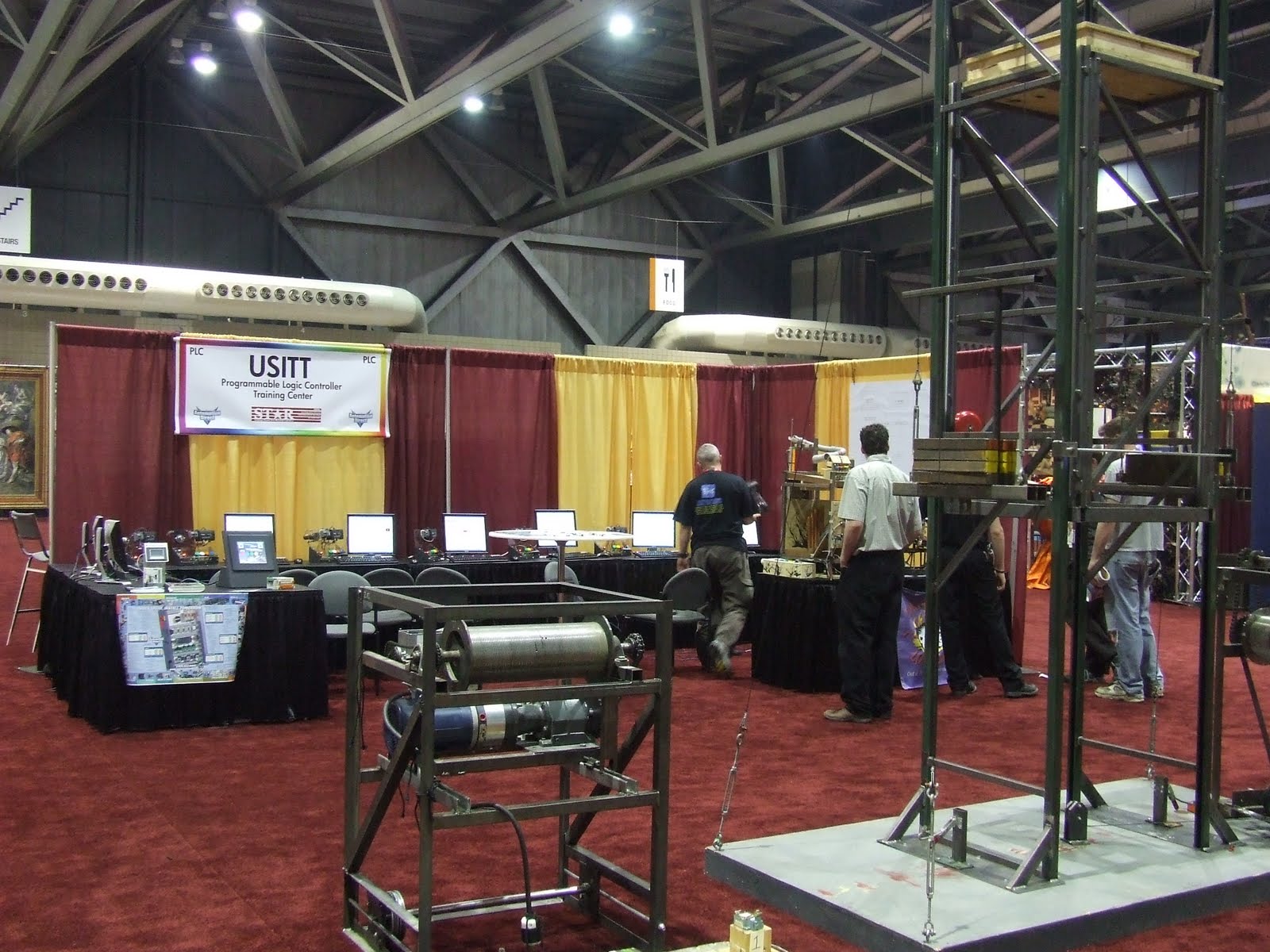
USITT Tech Expo

I think it would be great if a set up like this was in every automation class. The automation components are only a couple hundred bucks per station, and the TD program usually has a number of stations for AutoCAD already. I would like to add a pile of Lego's for platforms, and Knex for rigging, and you could prototype an effect in the very early stages of the technical design.

This is one of the drops from the USA painters the day before.
I wanted to show the work of the below expo exhibits because I especially liked the documentation that they demonstrated.




Saturday, April 3, 2010
USITT Blogs
My internet connection here at the conference has been pretty spotty, but I will be on my way home tomorrow, and will be able to upload from there photos and session notes from the past couple days in Kansas City. the conference has been great and I am looking forward to sharing!
Meanwhile, TD Squared and Theatreface has been blogging, so take a look at their sites and see what they have seen here at USITT.
Also check out John Huntington's blog Control Geek as he was at the conference as well.
Meanwhile, TD Squared and Theatreface has been blogging, so take a look at their sites and see what they have seen here at USITT.
Also check out John Huntington's blog Control Geek as he was at the conference as well.
Wednesday, March 31, 2010
USITT Info
A couple of notes about this years USITT.
If you aren't in KC to be here, you can see a coupe sessions via live streaming:
http://www.usitt.org/ConferenceLiveWebStreaming.aspx
If you are in KC, you can attend the stage expo for FREE! USITT is giving out complimentary passes here:
http://www.usitt.org/AttendStageExpo2.aspx
You can also follow the conference on Twitter #USITT
They have some pictures from set-up yesterday - worth a look!
If you aren't in KC to be here, you can see a coupe sessions via live streaming:
http://www.usitt.org/ConferenceLiveWebStreaming.aspx
If you are in KC, you can attend the stage expo for FREE! USITT is giving out complimentary passes here:
http://www.usitt.org/AttendStageExpo2.aspx
You can also follow the conference on Twitter #USITT
They have some pictures from set-up yesterday - worth a look!
USITT 2010
USITT is here again, and I am excited to be here in Kansas City! As the evenings allow I will be posting pictures and blogs about the sessions I see. Today, I will only be doing the expo floor - but it will be nice to have a good chunk of time to explore!
Tuesday, April 14, 2009
Bringing Order to the Chaos
There was one last topic from USITT that I wanted to discuss – the session Mr. Sammler did “Bringing Order to the Chaos”. It was an interesting and very valid session.
-I think the first comment I have is that the session is indicative to where technical direction is going. That the position is becoming more managerial. I think that in today’s age of technical capacity, you can no longer be a jack of all trades as effectively, and that the TD position must be able to pull together the resources needed, not necessarily be able to do everything.
-The key to the system that Sammler proposes is that everyone on the team operates in the same manner. The system must be set up so that budgets are combined for the show and that extra money in costumes goes to scenery or vise versa. If a shop can keep money and use that towards a different show, or for shop improvements or maintenance, then they will be tempted to hoard the money and not be transparent. However, the bulk of the places I have worked provided each shop with a budget, and that money can be used from show to show. I assume that moving around money from department to department is harder for the money people – and I have tended to only see a show based budget work in smaller theatres.
-For the per show budget technique to work, each department must budget, and do so in advance. Many theatres don’t require every department to do an estimate for every show. This is particularly true for lighting and sound. When I have tried to implement this type of system, I found that lighting was a challenge because they wanted till much later in the schedule to determine what they were using. Though I should note that I was working with a Canadian Lighting designer, and that the typical schedules are different (they often do not do a plot until after they see a run through – much later in the process than we do). Without being able to assess the needs of every department, the director can’t make an informed decision about where the money should be allotted.
-I thought it was interesting to hear is views on what a TD should be responsible for. For instance, He stated that it is not the TD’s job to value engineer the set to fit inside the provided budget. The TD should estimate what they feel is necessary to do the design as indicated and communicate those costs (time and materials). At that point director / designer can clarify what they need and where their priorities are to make choices involving all elements, and decide where they want the money to be spent. Perhaps that means that the costumes become simpler, and the scenery budget is allowed as is. Estimates should be tight, but reasonable. An estimate represents the TD’s plan to accomplish the design as they understand it. If the TD must get the show “into budget” it changes the relationship with the team and makes them a “no” person. The 10% contingency cannot be cut from the budget and allows flexibility to achieve the plan.
-It’s easy to budget enough to cover the set.
-Most people under estimate the amount of time it will take to build.
-The TD (or department head) cannot estimate what they don’t know about. If a production manager holds them accountable for things they didn’t know about the Dept. Head will hide money to cover themselves.
-When meeting – it is more about sharing the plan than sharing the budget. This allows everyone to look at what was included, and helps communication between departments – For instance costumes may see that the paint department is planning on texture and that makes a difference to their costumes.
I think that in an ideal work, this is a nice idea. But for this to work there has to be a lot of people who are all operating on the same page. And the production manager / organization has to be open in operating in this manner. And I think that’s a tall order. And practically, if you are in the situation where it isn’t ideal, and you can’t change the whole system to reflect the management system above – quitting your job cause you shouldn’t work in a place like that isn’t really always practical. Though, I suppose, with the rate that Yale churns out students, eventually there is a chance that this way of operating will become more common….
-I think the first comment I have is that the session is indicative to where technical direction is going. That the position is becoming more managerial. I think that in today’s age of technical capacity, you can no longer be a jack of all trades as effectively, and that the TD position must be able to pull together the resources needed, not necessarily be able to do everything.
-The key to the system that Sammler proposes is that everyone on the team operates in the same manner. The system must be set up so that budgets are combined for the show and that extra money in costumes goes to scenery or vise versa. If a shop can keep money and use that towards a different show, or for shop improvements or maintenance, then they will be tempted to hoard the money and not be transparent. However, the bulk of the places I have worked provided each shop with a budget, and that money can be used from show to show. I assume that moving around money from department to department is harder for the money people – and I have tended to only see a show based budget work in smaller theatres.
-For the per show budget technique to work, each department must budget, and do so in advance. Many theatres don’t require every department to do an estimate for every show. This is particularly true for lighting and sound. When I have tried to implement this type of system, I found that lighting was a challenge because they wanted till much later in the schedule to determine what they were using. Though I should note that I was working with a Canadian Lighting designer, and that the typical schedules are different (they often do not do a plot until after they see a run through – much later in the process than we do). Without being able to assess the needs of every department, the director can’t make an informed decision about where the money should be allotted.
-I thought it was interesting to hear is views on what a TD should be responsible for. For instance, He stated that it is not the TD’s job to value engineer the set to fit inside the provided budget. The TD should estimate what they feel is necessary to do the design as indicated and communicate those costs (time and materials). At that point director / designer can clarify what they need and where their priorities are to make choices involving all elements, and decide where they want the money to be spent. Perhaps that means that the costumes become simpler, and the scenery budget is allowed as is. Estimates should be tight, but reasonable. An estimate represents the TD’s plan to accomplish the design as they understand it. If the TD must get the show “into budget” it changes the relationship with the team and makes them a “no” person. The 10% contingency cannot be cut from the budget and allows flexibility to achieve the plan.
-It’s easy to budget enough to cover the set.
-Most people under estimate the amount of time it will take to build.
-The TD (or department head) cannot estimate what they don’t know about. If a production manager holds them accountable for things they didn’t know about the Dept. Head will hide money to cover themselves.
-When meeting – it is more about sharing the plan than sharing the budget. This allows everyone to look at what was included, and helps communication between departments – For instance costumes may see that the paint department is planning on texture and that makes a difference to their costumes.
I think that in an ideal work, this is a nice idea. But for this to work there has to be a lot of people who are all operating on the same page. And the production manager / organization has to be open in operating in this manner. And I think that’s a tall order. And practically, if you are in the situation where it isn’t ideal, and you can’t change the whole system to reflect the management system above – quitting your job cause you shouldn’t work in a place like that isn’t really always practical. Though, I suppose, with the rate that Yale churns out students, eventually there is a chance that this way of operating will become more common….
Tuesday, April 7, 2009
Prop Books
These are some of the recommended books that came up in the USITT session on period details.

The Bullfinch Anatomy of Antique Furniture
Antique Directory of Furniture
Authentic Decor All books by Peter Thornton were highly recommended.
Period Details - A Sourcebook for House Restoration.
Encylopedia of Furniture
Also interesting in this session was that I learned that the "bentwood" chair, that every theatre I have ever worked at seems to own in mass was #18 made by Gebruder Thonet. As I was looking up the chair I ran across another potential prop sight - the Chair Blog.

The Bullfinch Anatomy of Antique Furniture
Antique Directory of Furniture
Authentic Decor All books by Peter Thornton were highly recommended.
Period Details - A Sourcebook for House Restoration.
Encylopedia of Furniture
Also interesting in this session was that I learned that the "bentwood" chair, that every theatre I have ever worked at seems to own in mass was #18 made by Gebruder Thonet. As I was looking up the chair I ran across another potential prop sight - the Chair Blog.
Wednesday, March 25, 2009
USITT Resources
I wanted to plug a few resources available through USITT. If you don't visit the commission pages through USITT you are missing alot of good archived information. I do wish that they were a little more "equal" - Like the Technical Production sight has links to past conference session notes, which many of the others don't - and it is a great resource.
First is the Technical Production Commission run by Patrick Immel. There are alot of great resources, including past session notes. The session notes have not yet been updated, but the slides from my session will be included there as well. The other great resource that I want to point out is the Technical Source guide ONLINE! I encourage you to submit your cool projects to the site. It doesn't need to be ground-breaking - there are alot of cool processes out their that we assume is common knowledge that really isn't written down anywhere, and that really is common knowledge when you have worked with X person in X shop.... Plus there are often variations on a theme. For instance, Eric Hart on his Props blog, talks about a process using glue and joint compound to create a skim coat for coating wiggle wood. This mixture seems to be one of many that I have heard over the years, some with additions for other textures, and uses. It would be interesting to me to have some place where everyone can right in their recipes, and what they are good for (much like I have seen lists of blood recipes online).
The education commission has resources available for Creative projects for teaching technical production.
The Costume Commission has an active page here.
The Engineering Commission has information about codes, standards, dmx and ETCP certifications.
The health and Safety Commission has a variety of resources available.
The Lighting commission has information about the recommended practice for lighting design graphics here.
There are also sound, management and other commissions as well - so visit USITT to check them all out. And don't forget to submit an article to the Technical Source Guide ONLINE!
First is the Technical Production Commission run by Patrick Immel. There are alot of great resources, including past session notes. The session notes have not yet been updated, but the slides from my session will be included there as well. The other great resource that I want to point out is the Technical Source guide ONLINE! I encourage you to submit your cool projects to the site. It doesn't need to be ground-breaking - there are alot of cool processes out their that we assume is common knowledge that really isn't written down anywhere, and that really is common knowledge when you have worked with X person in X shop.... Plus there are often variations on a theme. For instance, Eric Hart on his Props blog, talks about a process using glue and joint compound to create a skim coat for coating wiggle wood. This mixture seems to be one of many that I have heard over the years, some with additions for other textures, and uses. It would be interesting to me to have some place where everyone can right in their recipes, and what they are good for (much like I have seen lists of blood recipes online).
The education commission has resources available for Creative projects for teaching technical production.
The Costume Commission has an active page here.
The Engineering Commission has information about codes, standards, dmx and ETCP certifications.
The health and Safety Commission has a variety of resources available.
The Lighting commission has information about the recommended practice for lighting design graphics here.
There are also sound, management and other commissions as well - so visit USITT to check them all out. And don't forget to submit an article to the Technical Source Guide ONLINE!
USITT Ursula Belden

USITT also did an exhibit honoring Ursula Belden who passed away early this year. USITT Sightlines published an article about her, and her webpage can still be found online.
The picture below is from The Dyybuk, which she did at Syracuse Stage during my last year there. She took it to the PQ 2003 exhibit as well.

Tuesday, March 24, 2009
USITT Ohio Valley Exhibits
USITT had a variety of exhibits worth mentioning. The first picture is a truck for the Grapes of Wrath from Ohio University. Each prop had a description about the process of design, development and the parameters the prop had to fill. It was very interesting to read.

Ohio State University presented a variety of design work and models from the Jerome Lawrence and Robert E. Lee Research Institute. OSU also exhibited a collection exploring the London Notting Hill Carnival. Click here for more about the Research Insitute.

There was also displays showcasing regional theatre design and entries from the Peggy Ezekiel Award competition.

Ohio State University presented a variety of design work and models from the Jerome Lawrence and Robert E. Lee Research Institute. OSU also exhibited a collection exploring the London Notting Hill Carnival. Click here for more about the Research Insitute.

There was also displays showcasing regional theatre design and entries from the Peggy Ezekiel Award competition.
Monday, March 23, 2009
USITT Notes
OnThere are no bad ideas, the recent entry asks about what is missing on the USITT expo floor. I think I would ad to his list the Hossfeld people, and perhaps hardware / caster suppliers.
The Daily AutoCAD blog had a tutorial for getting section views from 3-D solids, relating the the 3D Studio Max comments I made the other day.
The track that I liked from Thern can be seen here:
http://www.hallstage.com/uploads/documents/T60%20Leaflet.pdf
http://www.hallstage.com/uploads/documents/T60%20Details.pdf
http://www.hallstage.com/product/productlist.asp?catid=4
http://www.hallstage.com/uploads/documents/T70%20Leaflet.pdf
http://www.hallstage.com/uploads/documents/T70%20Details.pdf
I like the built-in alignment system.
The Daily AutoCAD blog had a tutorial for getting section views from 3-D solids, relating the the 3D Studio Max comments I made the other day.
The track that I liked from Thern can be seen here:
http://www.hallstage.com/uploads/documents/T60%20Leaflet.pdf
http://www.hallstage.com/uploads/documents/T60%20Details.pdf
http://www.hallstage.com/product/productlist.asp?catid=4
http://www.hallstage.com/uploads/documents/T70%20Leaflet.pdf
http://www.hallstage.com/uploads/documents/T70%20Details.pdf
I like the built-in alignment system.
Thoughts on USITT's Cover the Walls Exhibit
I think that the Cover The Walls exhibit is a great way to share designs (lighting, costume, scenic and technical. It's open to everyone at a relatively low cost. It allows the viewers to see what shows are being done, how they are being approached, and generate new ideas of their own. Its also a great way for acedemia to get out the word about what they are doing at a location where they are recruiting, and for people who are looking for work at USITT to exhibit a portfolio piece.
Despite what reasons people choose for participation, there are a number of ways to approach the final appearance. This year I would say the exhibits were either the traditional pages pined (or attached with double stick tape or velcro) in an artistic array over the space, prearranged foamboard displays attached to the wall, printed / plotted displays, and 3-demensional works. There are some that mix - Mine was plotted, but with full color photos and bluelines attached, and some used a fabric background, with applied works.
There are a couple things to keep in mind when designing the display. They supply pins and hammers, but it's better to design in an attachement method, as the pins are a pain. Make sure your double stick tape is hefty enough to hold your stuff (I made this mistake the first year and needed to resort to pins). They say no 3-D, people do it, but make sure you bring what you need to support the element on your panel. Panel design is important. No matter how nice your work is, if it looks sloppy, it reflects on you. This is like a temporary portfolio review that hundreds of people look at - while not being able to ask any questions to clarify what you were trying to convey. The design needs to supply all the important information in an eye pleasing manner that uses the provided space well.
The pictures below reflect the variety of the displays. The first was done with foamcore boards.

On the one below, I liked the center one with the fabric. The one on the right that was printed was nice, but might have been easier to read if it took up a little more of the panel space.

I liked the 3 demensional elements on this one.

The bottom two was my favorite display. It is obvious that the design took alot of time with the display.


Despite what reasons people choose for participation, there are a number of ways to approach the final appearance. This year I would say the exhibits were either the traditional pages pined (or attached with double stick tape or velcro) in an artistic array over the space, prearranged foamboard displays attached to the wall, printed / plotted displays, and 3-demensional works. There are some that mix - Mine was plotted, but with full color photos and bluelines attached, and some used a fabric background, with applied works.
There are a couple things to keep in mind when designing the display. They supply pins and hammers, but it's better to design in an attachement method, as the pins are a pain. Make sure your double stick tape is hefty enough to hold your stuff (I made this mistake the first year and needed to resort to pins). They say no 3-D, people do it, but make sure you bring what you need to support the element on your panel. Panel design is important. No matter how nice your work is, if it looks sloppy, it reflects on you. This is like a temporary portfolio review that hundreds of people look at - while not being able to ask any questions to clarify what you were trying to convey. The design needs to supply all the important information in an eye pleasing manner that uses the provided space well.
The pictures below reflect the variety of the displays. The first was done with foamcore boards.

On the one below, I liked the center one with the fabric. The one on the right that was printed was nice, but might have been easier to read if it took up a little more of the panel space.

I liked the 3 demensional elements on this one.

The bottom two was my favorite display. It is obvious that the design took alot of time with the display.


Sunday, March 22, 2009
USITT - Saturday

Today's excitement on the floor was Foy, ZFX, and Hall Associates flying people. The above picture is the ZFX rig.
Besides spending a few remaining minutes on the show floor, I saw two sessions today. The first was "Technical Design / Direction - In a Disney Theme Park". Chuck Davis gave an interesting view into the scale and process that goes into creating a major park element. I think what was interesting to me was the degree that they come up with an idea, but they have to internally sell the idea to get funding. Since these projects are worth millions, they spend hundreds of thousands of dollars proving the ideas and methods as they proceed. While we certainly don't produce on the scope of Disney, we also often don't invest in enough time planning and determining if something will work before we are well into the process and committed. I think sometimes we would be well served to remember that spending some preliminary funding to investigate a technique before commitment allows for a smoother process, and money saved in the long run.
Next I went to "Draw Me a Picture: Collaborative Problem Solving through Digital Storyboarding". It was chaired by Robert W. Johnson, and the presenters included Gregory K. Bell, and Greg Stump. The session was an interesting view on how technology is improving and growing as a communication tool. Some of the packages that we receive are fully storyboarded, and 3-D rendered, and I suspect that much of that is to sell the product, not really for building, but it helps on the build side as well. In 3D Studio Max they showed off the section tool to get 2-D sections from a complex 3-d shape. That is a handy feature, but not enough for me to buy the program. They also talked about modeling a complex 3-D shape (a bust for Mozart) and then doing a section about every 1/2, which was then used to machine the shape. After that they did fine tooling, and made a mold from the piece to make multiples. As great as cnc machining is, I take from this, that it still isn't to the place where it is easier to simply machine something than it is to make a mold and cast duplicated. (Which for complex 3-D items is true where I work as well). The other design they talked about was a structure used for Jesus Christ Superstar where the cross was on a cantilevered beam, and after being crucified, the cross slid back, leaving Jesus hanging against a black background. The set was cool, and the 3-D software helped them animate the sequence to make sure that everyone knew what they were looking for and to help start the technical discussions. The middle part of the session was about how they accomplished the effect. The last part largely revolved around SketchUp. having heard and seen alot of the program, I fully agree to its usefulness. The presenter showed using it to define the structure, and building off of drawings created by SketchUp. This is certainly intriguing, and though he said the tolerances were much more precise than what we need in theatre, I still am suspect. For instance I know some people who routinely use it for preliminary design development, but when it comes time to build, the tolerances are usually +/- inches - far too big to use for build.
The last session of the conference for me was "Tricks of the Stage - Stage Magic". It was nice to see so many prop related sessions this year, and I enjoyed this one as well. John M. Lavarnway chaired the session and went through, with input from his other panelists, how to put together the effect. He stressed defining the effect, research, covering liability concerns, reliability concerns, and how to work with the Actors with the trick. They then showed a variety of effects such as using solenoids for Blithe Spirit, the throwing knife trick, and turning wine into water.
By the time that session let out the expo had been closed for about 45 minutes or so, and the strike was quickly proceeding.
Friday, March 20, 2009
USITT Blog
(TD) Squared has a blog about their trip to USITT. Check it out for some session info on sessions I wasn't able to attend.
Thursday, March 19, 2009
USITT Day 2
The Stage Expo is open and there were lots of things to see. The way the day worked out for me I only went to 2 sessions. The Technical Production Reception was great, and I got to hear what some members are thinking about. Cirque Du Soleil's "Behind the Proscenium" was disappaointing to me. I had heard such good press about their past sessions, I thought I would go (despite numerous other enticing options), and it was really just a "how you can work for us" session.
The Sky Hook from the Tech Expo

Low Profile Drop-Stop Wagon from the Tech Expo

Tech Expo Shot

A Snapping Hook

The expo floor

The Sky Hook from the Tech Expo

Low Profile Drop-Stop Wagon from the Tech Expo

Tech Expo Shot

A Snapping Hook

The expo floor

Wednesday, March 18, 2009
USITT Cover the Walls

This is my Cover the Walls exhibit this year. While the exhibit is marketed towards designers,but I figure technical design counts. Actually, despite the terms on the exhibit form, they welcome the TD's into the fold, and I would like to encourage more of you to show your work in upcoming years. I hope when the exhibit opens tomorrow to have some exciting shots of the Expo Floor, Tech Expo and the finished Cover The Walls exhibit.
USITT 2009 Day 1

Greetings from Cincinnati!
Day 1 has gotten off to a great start - through a long one. This year promises alot of great sessions, and so far so good. One of the things I really like about teh Duke Energy Center is that the second floor has large windows that overlook the stage expo space. So though I was able to see some of the set up when I was putting up my cover the walls exhibit and helping with the Tech Expo, I could also see how things were progressing in between sessions.
I managed to sneak in a full day of sessions as well. I started off with the Automation 101 - Brakes. Chair Alan Hendrickson and presenter Aaron Bollinger did a great job defining and explaining types of brakes, sizing, and control. One of the resources they pointed out was Accident-Prevention Regulation for Staging and Production Facilities for the Entertainment Industry.
As the Stepper Motor session was canceled, I instead went to "Period Style in the Smallest Detail" discussing period furniture, and the collaboration between the designer and director and the designer and prop master. The panel was chaired by Elizabeth Popiel and the presenters were Barbara Craig, Pam Lavarnway and Karen Rabe. They provided alot of production shots showing how they solved period related challanges, and talked about ways to achieve the effect without rebuilding the units historically accurately. They also talked alot about the process of communication. I think one of the best takeaways was that they stressed visual research and communication - not just terms or verbal discussions. They also had a variety of reference materials that they suggested, and I will try to post that once I get back to chicago and can sort through all of my notes better.
I managed to slip into the education poster session at the last minute and check out a little of that as well. I think the two things to note there was a project discussing the uses of facebook for production work, and a poster on using cad and the photocopier to make wallpaper for white models and model period furniture.
The next two sessions I went to was the Technical Production Leadership Meeting and the Managers Forum. I will admit I was a little disappointed in the managers forum. It seems like the only good question the can answer is where to look for a job. It was nice to think of some arts admin stuff though - I don't think in thos terms very often anymore. There were several questions dealing with staff that aren't up to par, but with hiring freezes, they can't be replaced, sexual harrasment as it relates to the costume shop and fittings and so forth. It was probbaly one of the few sessions I have attended in that commission, so it was interesting to see some new faces.
Last but not least was Ben Sammlers / Amanda Haley's "Bringing Order to the Chaos". It was a good session. I liked the first part best, because alot of the later part talked specifically about the Yale Budget Template, and I have been using that process for a number of years. What was more interesting to me was some of the ideas behind the template, and how he viewed his job as a Production Manager, and was he expected out of a Technical Manager. I actually have quite a few notes / comments to share with you regarding this session- but will probably be after the conference when I can get back to this.
For those of you reading this who are here in Cincinnati as well, what were your thoughts about the first day?
Wednesday, January 28, 2009
Creativity
Seth Godin posted an interesting link about creativity. basically he states that what may be creative for one person, may actually not be very creative at all by another stand point. He uses the example of a police officer solving a crime with what looks like to be creative methods from the outside, but is actually a very formal technique. Then he likens creativity to stretching the edges, which like an old sweatshirt, you may have to push further and further to be on the edge.
Why bring this topic up here? I think sometimes stagecraft is like an old sweatshirt. You enter the industry - you get your shirt. You poke around the edges, you work creatively. Then you settle in on techniques and processes that tend to work, and you get comfortable and stop pushing the limits.
To take it even a step further, I would even say that collectively the industry has a shirt, with alot of different people poking around at the various edges. You have some people on the very edge creating and trying out the latest gear and ideas, and you have some in the middle staying stable, and in a holding pattern. The catch here is twofold. Not only do we as an industry need to be at the edges, but we need to do so collectively. This is why I believe in the Tech Expo, and Yale's Tech Briefs, and why I try to post here. Only by sharing information, and making it apart of the common knowledge available can we continue to push the real edge. Otherwise you'll have some guy in the middle wildly poking at the seam on their edge, while that same idea is pretty boring to others around him. Point is, the more we grow as an industry, the more we need to lay down the path for others to follow. So much of what we learn is learned on the job by respected people in the industry and is passed on orally. We take so much of our normal construction techniques for granted I think it is sometimes hard to identify new ideas. But I challenge you all to document, write up, blog, or otherwise submit ideas, techniques, and solutions.
You can submit ideas to the Technical Production Commission here. Also, don't forget the Answer Box section of Stage Directions, Yale Tech Briefs, and the Tech Expo.
Why bring this topic up here? I think sometimes stagecraft is like an old sweatshirt. You enter the industry - you get your shirt. You poke around the edges, you work creatively. Then you settle in on techniques and processes that tend to work, and you get comfortable and stop pushing the limits.
To take it even a step further, I would even say that collectively the industry has a shirt, with alot of different people poking around at the various edges. You have some people on the very edge creating and trying out the latest gear and ideas, and you have some in the middle staying stable, and in a holding pattern. The catch here is twofold. Not only do we as an industry need to be at the edges, but we need to do so collectively. This is why I believe in the Tech Expo, and Yale's Tech Briefs, and why I try to post here. Only by sharing information, and making it apart of the common knowledge available can we continue to push the real edge. Otherwise you'll have some guy in the middle wildly poking at the seam on their edge, while that same idea is pretty boring to others around him. Point is, the more we grow as an industry, the more we need to lay down the path for others to follow. So much of what we learn is learned on the job by respected people in the industry and is passed on orally. We take so much of our normal construction techniques for granted I think it is sometimes hard to identify new ideas. But I challenge you all to document, write up, blog, or otherwise submit ideas, techniques, and solutions.
You can submit ideas to the Technical Production Commission here. Also, don't forget the Answer Box section of Stage Directions, Yale Tech Briefs, and the Tech Expo.
Subscribe to:
Posts (Atom)


