Over the holiday weekend, in the midst of doing a variety of home projects I watched the 1st (only) season of Prototype This.
The show has a core team of 4 (an electrical engineer, special effects guru, Robotics guy, and a material specialist) that join together to put together some amazing prototypes during a 10 day to 2 week period. Some of the projects they tackled were a mind controlled car that went into neutral when the driver got angry,
a backyard water slide simulator, and a flying life guard, supplying life saving floatation devices to unmanned beaches.
I liked the series, and would recommend it for several reasons.
-They use alot of materials that are used in theatre
-They show alot of different machining technologies, cnc machines, vaccuforming, laser cutting, water jetting
-They use a variety of animation / feedback and other items useful to automation.
-It shows that you can do some amazing things in 2 weeks with the right resources (granted they weren't two 40 hour weeks).
-While cash certainly wasn't an issue (budgets other than time were not even mentioned), using resources wisely was important to meet their goals. They often went to the top of the field for what they were trying to accomplish to get ideas and gain knowledge.
-I think the prototyping process is important, and too often overlooked. And, on top of being important for the realization of a finished product, challenging yourself to do a proof of concept can help you learn a variety of skills even if a finished product is not the end goal.
So if you have a few hours, take a look!
Tuesday, June 1, 2010


Tuesday, May 18, 2010
History of Video Walls
Blooloop has an article on the history of the video wall. It's worth a read. I first remember seeing this technology with the Who's Tommy.
Also on the site is an article about
USITT.
As with the above resource, it is not specifically theatre related. While I always "knew" that there were many different types of entertainment that used either technical directors specifically, or an equivalently named position, I really didn't fully grasp how many different places utilize the same skill sets that TD's nurture. Just as every show is a little different, not every museum job or attraction, or event, or trade show is the same, but all of these jobs require similar skill sets. For instance, all require planning and organizational skills, knowledge of a wide variety of construction techniques, materials, estimating, communication skills among the many other skills TD's must utilize.
Thursday, May 13, 2010
Addams Family
With the opening of Addams Family on Broadway, my articlediscussing how we built the ground row including doing the lighting for all of the city lights. PRG also has an article in the issue that you should check out.
Exhibit Builder also ran an article about the show.
I enjoyed building the piece for a variety of reasons. Mostly, the project offered a challenge due to aligning the graphic to the substrate, while making the lights assessable. But first the graphic needed to be finalized. The beginning of the project started with samples of the printed graphic with multiple colors of grain of wheat lamps hooked up so that we could test how brightly the lamps would show. This led to a subsequent sample where a graphic was printed that had about 10 different percentages of transparency (ink), for the windows, each with lighting behind so that the final image could be modified to the desired window transparency. Once the graphic was off the printers, we had the experience of the samples to lead the way through the rest of the construction process.
It was a fun piece to build!
Monday, May 10, 2010
Foam Coat
Rosco has a story about how they created a short article about how an entryway was carved from foam, covered with foam coat and painted. I think it is interesting that while the foam coat was wet, they sprinkled sand on top - I have mixed sand into paint before for texture / traction, but this works as well to help with the up-close realism that museums must offer guests.
Friday, May 7, 2010
Hardware Terminology

Sometimes the hardest part about finding the ideal piece of hardware is knowing what to call it. For example, as simple as a slip on flange cover plate (for square tube) may seem, it took me a good half hour to find what I was looking for. The interesting thing to note, is that for the square shape, it is a cover plate - but if it is for round tube, it is a flange canopy. I finally found what I was looking for at Wagner which offers a variety of railing systems and components.
Thursday, May 6, 2010
Draw Catch
While ordering a few run of the mill door catches, I came across this at McMaster Carr. 
These remote actuation cable latches allow doors to be opened remotely. McMaster describes them as:
These seem like they would be a great low-tech way to do a variety of special effects. I could have used something like that when I did Blithe Spirit a few years back.

These remote actuation cable latches allow doors to be opened remotely. McMaster describes them as:
Operate these latches from a distance—a flexible cable connects the latch and the T-handle. Pull on the handle to retract the round, spring-loaded bolt. Because the cable is flexible, you can bend it around corners and other obstructions. Min. bend radius is 1.5". The recommended maximum amount of total bending is 720° . You have two mounting options: through-hole mount the handle and bolt housing(s) or surface mount them using the included mounting plates. The through-hole mounting size for the handle is 1/2". The through-hole mounting size for the bolt housings is 9/16".
Handles are plastic. Bolts are zinc-plated steel. Mounting plates are 12-ga. steel with a black-oxide finish and require #10 screws (not included). Strike plates are Type 304 stainless steel and require 1/4" screws (not included).
Please specify cable length: 2, 3, 4, 5, 6, 7, 8, or 9 feet.
These seem like they would be a great low-tech way to do a variety of special effects. I could have used something like that when I did Blithe Spirit a few years back.
Monday, April 5, 2010
ISquint @ USITT
isquint is another source of good information about the conference in Kansas City. It is written by Justin Lang, and he covers alot of ground, particularrly about new technology.
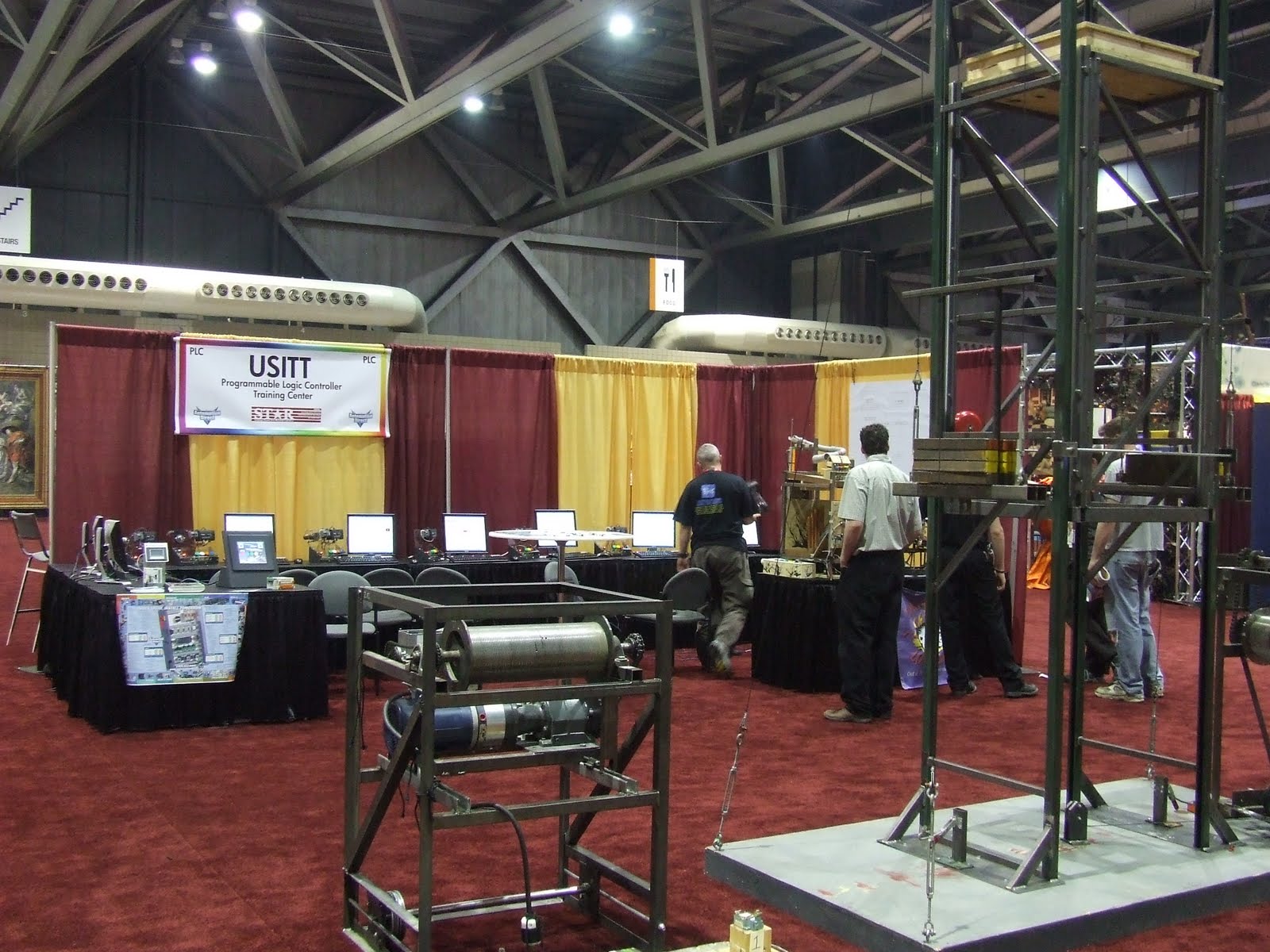
USITT Tech Expo

I think it would be great if a set up like this was in every automation class. The automation components are only a couple hundred bucks per station, and the TD program usually has a number of stations for AutoCAD already. I would like to add a pile of Lego's for platforms, and Knex for rigging, and you could prototype an effect in the very early stages of the technical design.

This is one of the drops from the USA painters the day before.
I wanted to show the work of the below expo exhibits because I especially liked the documentation that they demonstrated.




Saturday, April 3, 2010
USITT Blogs
My internet connection here at the conference has been pretty spotty, but I will be on my way home tomorrow, and will be able to upload from there photos and session notes from the past couple days in Kansas City. the conference has been great and I am looking forward to sharing!
Meanwhile, TD Squared and Theatreface has been blogging, so take a look at their sites and see what they have seen here at USITT.
Also check out John Huntington's blog Control Geek as he was at the conference as well.
Subscribe to:
Posts (Atom)


