"You can fix it on the drawing board with an eraser or you can fix it
on the site with a sledgehammer."
-Frank Lloyd Wright
Wednesday, April 30, 2014


Friday, April 25, 2014

Thursday, March 27, 2014
Design Fees
Recently, I talked to a couple of designers that I have worked with previously about an upcoming potential job. They told me that they wouldn’t do it “on spec” which, I have to admit, took me back a bit because I didn’t expect them to do the work for free.
In theatre, designers, in my experience, are hired based on their reputation, portfolio, and so forth. It is common for certain directors to request a certain designer based on the show and a previously existing relationship. Designers, at least professionally, are not expected to work for free. Once hired, they are expected to make the design work for the director.
Working in a commercial scene shop, some clients think of design the same way that I do – that they hire us based on reputation, relationship and portfolio, and we work together to make a design that everyone is happy about. Technically, we could do a design and not do the fabrication, though that doesn’t happen often. Also, I suppose that if a design wasn’t going well, they could pay for services to date and move on, though that doesn’t really happen either. However, there are a variety of customers, who work in other industries where they do expect us to design and/or sample and develop ideas for free. There is really quite a debate about this practice & about how it can be bad for the industry in general. It reminds me of the debate I heard when I was younger about how the theatre industry underpays in general, but especially for interns because it’s a learning experience and besides – you are doing what you love. I have to admit that my early days in theatre were in small places that economically took advantage of me, but I did gain a lot of experience. On the other hand, I have seen others take a much different career trajectory.
The other challenge with design and prototype / sample proposals is quantifying what they entail. If it is unlimited, a client could take advantage wanting endless samples, drawings, revisions, and so forth. If you price based on the assumption that something like that will happen and try to allow for time and materials, your cost will be too high. If you assume the best case scenario, but don’t put any limits into the contract then you may lose money on the work. I have some people do a time/materials proposal, but generally people want to have a final price in mind for the budget. If you do a proposal that specifies a particular process and amount of revisions etc, and allows for additional charges – it allows everything to be very clear to both parties, and minimizes risk to the artist, but I have seen clients shy away-to a certain degree once they pay for design they want it to be finalized without additional charges and have a hard time recognizing how their actions and request increase costs.
While I don’t really have answers, I think that ultimately it is about a relationship.
David Airey has a blog that talks about spec work. He also has many good resources for designers.
In theatre, designers, in my experience, are hired based on their reputation, portfolio, and so forth. It is common for certain directors to request a certain designer based on the show and a previously existing relationship. Designers, at least professionally, are not expected to work for free. Once hired, they are expected to make the design work for the director.
Working in a commercial scene shop, some clients think of design the same way that I do – that they hire us based on reputation, relationship and portfolio, and we work together to make a design that everyone is happy about. Technically, we could do a design and not do the fabrication, though that doesn’t happen often. Also, I suppose that if a design wasn’t going well, they could pay for services to date and move on, though that doesn’t really happen either. However, there are a variety of customers, who work in other industries where they do expect us to design and/or sample and develop ideas for free. There is really quite a debate about this practice & about how it can be bad for the industry in general. It reminds me of the debate I heard when I was younger about how the theatre industry underpays in general, but especially for interns because it’s a learning experience and besides – you are doing what you love. I have to admit that my early days in theatre were in small places that economically took advantage of me, but I did gain a lot of experience. On the other hand, I have seen others take a much different career trajectory.
The other challenge with design and prototype / sample proposals is quantifying what they entail. If it is unlimited, a client could take advantage wanting endless samples, drawings, revisions, and so forth. If you price based on the assumption that something like that will happen and try to allow for time and materials, your cost will be too high. If you assume the best case scenario, but don’t put any limits into the contract then you may lose money on the work. I have some people do a time/materials proposal, but generally people want to have a final price in mind for the budget. If you do a proposal that specifies a particular process and amount of revisions etc, and allows for additional charges – it allows everything to be very clear to both parties, and minimizes risk to the artist, but I have seen clients shy away-to a certain degree once they pay for design they want it to be finalized without additional charges and have a hard time recognizing how their actions and request increase costs.
While I don’t really have answers, I think that ultimately it is about a relationship.
David Airey has a blog that talks about spec work. He also has many good resources for designers.
Tuesday, March 25, 2014
New Stage Machinery in 1873
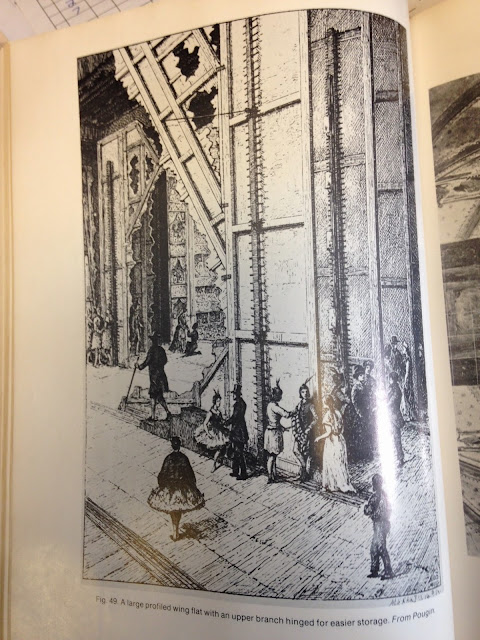
In an article “the New Theatre” published in the New York Times on 1873 (not to be confused with Claude Hagen’s new theatre that occurs 40 years “ish” later) also reference James Schonberg as contributing to designing the stage. The building is being done by architect, Frederick Draper. The proscenium “will be of original form and construction, the plans for it having been designed by Mr. Dion Boucicault, and will be so formed as to act as a sounding board.” The stage is described as having many improvements by Boucicault and Schonberg. The stage is described as 40 squares, each 3’ which can be raised and lowered. These could also be used to create steps. This article describes a patent by Schonberg for supporting and setting the scenery, but also describes traditional scenery (defining it by two types, English and French). The article describes French Stage shifting equipment as a truck beneath the stage with a ladder / frame that the scenery is mounted to. (Pictures below are from French Theatrical Production Nineteenth Century by J P Moynet). The article discusses advantages and disadvantages of this system. They describe the English system as having the scenery supported from above, by “grooves” or “parallel fillets”. This technique is said to be faster than the French system and able to be done in front of the audience. Disadvantages are that everything is square and that grooves must be masked. It also talks about stage screws and braces; obviously we have inherited many of these practices despite European theatrical influences. The article names Mr Flechter and the London Lyceum as advancing a system blending the techniques for shifting scenery, also including Boucicault and Schonberg. The new Lyceum Theatre (in NY) would be built with mechanisms described within the article (too lengthy to quote but freely available on the NY Times Archives Website).
In “Mr. Fechter’s Theatre”, published in the New York Times Jan 20, 1873, we see a continuation of the description of the theatre. It has a very elaborate account of the building itself. Included are items that involve fire safety such as doors that swing in both directions. The theatre was outfitted with gas lighting (that could change color and strength). The stage itself moved as well. The theatre includes a second “sounding-board” (proscenium) which moves upstage – downstage by way of stage machinery. The scenery is lifted from traps “upon what are termed parallel boats, are then attached to the stage, which, with the scenery upon it, can be moved completely out of sight of the audience.” Credit to the system was given to James Schonberg who was a stage manager at the Wallack’s Theatre, and the article states that he patented the system. W. Lester, a machinist, built the system. Absent from this account is Dion Boucicault’s contributions. Under the stage, the area is described as “a perfect labyrinth of cranks, wheels, parallel boats and other mysteries, all worked by hand”. The workshops are also under the stage, while the scenic painter’s gallery is behind the stage, in use by painters Hosford and Laran.
Further New York Times articles indicate that James Schonberg was also a playwright.
His patent can be seen online as well: US 123735
As a side note, I have come across many references to technicians referred to bay their last name only (though very politely). This makes tracing these names more difficult, if not impossible, at least with the fairly searches that I am doing within this research. I assume that they have shorted the names to save space, or because they considered the first names unimportant and not that there was an assumption that they were so well known that first names were not needed. I say this because many names that I am more familiar with are fully spelled out.



In “Mr. Fechter’s Theatre”, published in the New York Times Jan 20, 1873, we see a continuation of the description of the theatre. It has a very elaborate account of the building itself. Included are items that involve fire safety such as doors that swing in both directions. The theatre was outfitted with gas lighting (that could change color and strength). The stage itself moved as well. The theatre includes a second “sounding-board” (proscenium) which moves upstage – downstage by way of stage machinery. The scenery is lifted from traps “upon what are termed parallel boats, are then attached to the stage, which, with the scenery upon it, can be moved completely out of sight of the audience.” Credit to the system was given to James Schonberg who was a stage manager at the Wallack’s Theatre, and the article states that he patented the system. W. Lester, a machinist, built the system. Absent from this account is Dion Boucicault’s contributions. Under the stage, the area is described as “a perfect labyrinth of cranks, wheels, parallel boats and other mysteries, all worked by hand”. The workshops are also under the stage, while the scenic painter’s gallery is behind the stage, in use by painters Hosford and Laran.
Further New York Times articles indicate that James Schonberg was also a playwright.
His patent can be seen online as well: US 123735
As a side note, I have come across many references to technicians referred to bay their last name only (though very politely). This makes tracing these names more difficult, if not impossible, at least with the fairly searches that I am doing within this research. I assume that they have shorted the names to save space, or because they considered the first names unimportant and not that there was an assumption that they were so well known that first names were not needed. I say this because many names that I am more familiar with are fully spelled out.


Monday, March 24, 2014
Entertainment Design & Technology Blog
Jeromy Hopgood writes a blog called Entertainment Design & Technology. It is fairly new and has limited content, but the posts are interesting. I linked specifically to an entry about doing visual research.
Sunday, March 23, 2014
Stage Carpenter for Herne, the Hunter
I was reading an article from the New York Times Archive called “Broadway Theatre” published on Feb. 19. 1856 about a show called “Herne, the Hunter”. Evidently the show did not go well since the author states that “neither the scenery nor the machinery worked well. … Large demands are made on the stage carpenter, and it will be one or two nights before everything can be expected to work with exact precision.” Later though, the author claims that the scenery is good, but that it needs to be better lit.
This predates the first version of IATSE, which was the Theatrical Workman’s Council (started in 1863). It also seems to predate commercial scene shops, most of which seem to have started opening around 1890, though I am sure that there were builders operating before that out of a small shop, just as there are individuals today doing the same.
We have Stage Carpenters today of course; they typically help during load in, and run and maintain a show. If it’s a tour, the carpenter would likely be a Show Carpenter or perhaps a Technical Supervisor. Depending on the venue, a theatre may have an IATSE crew, and the “head” would be the steward. This person generally manages crew – but doesn’t usually handle dealings with the client, so it’s a tricky separation.
This predates the first version of IATSE, which was the Theatrical Workman’s Council (started in 1863). It also seems to predate commercial scene shops, most of which seem to have started opening around 1890, though I am sure that there were builders operating before that out of a small shop, just as there are individuals today doing the same.
We have Stage Carpenters today of course; they typically help during load in, and run and maintain a show. If it’s a tour, the carpenter would likely be a Show Carpenter or perhaps a Technical Supervisor. Depending on the venue, a theatre may have an IATSE crew, and the “head” would be the steward. This person generally manages crew – but doesn’t usually handle dealings with the client, so it’s a tricky separation.
Tuesday, March 18, 2014
Lab Theatre
Traditionally, when talking about a lab theatre, one might think about a black box space. Now however, we can test some technical ideas out in a model theatre, allowing experimentation before time is limited during tech week.
Yeagerlabs includes scaled softgoods and lighting packages.
Lightbox also has a scaled model of a theatre. I have seen this in use at USITT, but have also seen it in development at Syracuse University. This website seems to be out of date, so I am not sure if they are still in existence or not.
Both of these instruments seem to be primarily effective for lighting experimentation – still leaving room for future development for scenic automation experimentation.
Yeagerlabs includes scaled softgoods and lighting packages.
Lightbox also has a scaled model of a theatre. I have seen this in use at USITT, but have also seen it in development at Syracuse University. This website seems to be out of date, so I am not sure if they are still in existence or not.
Both of these instruments seem to be primarily effective for lighting experimentation – still leaving room for future development for scenic automation experimentation.
Tuesday, March 11, 2014
Carl Lautenschlager, Technical Director.
The earliest mention of a “Technical Director” within the New York Times is in an article titled “Conried Tells his Plans” published on May 14, 1903. Within the article Conreid (a producer) announces that Carl Lautenschlager will REMAIN with him as TD for work at the Metropolitan Opera House. The article also describes that a new lighting system, counterweight system, stage floor, and costumes will be purchased and installed, and a revolving stage is to be added a year later. These improvements are probably for “Parsifal”.
In a December 20, 1903 article in the New York Times, called “”Parsival,” The Music Drama” outlines the story. It announces the upcoming opening of the show. The article lists Lautenschlager as “Technical Director (in charge of all mechanical and electrical effects)” as part of the cast list. Further, the article indicates that Lautenschlager has rebuilt the stage and “devised” lighting, and claims that he “has no rival in his own field in Europe.” It is also interesting to note that “including the electricians, property men, stage hands, supernumeraries, and choruses, nearly 300 persons” are involved. While we cannot be certain how many of these people filled a technical role versus being on the stage, it does suggest a vastness of scale to the production.
Several days later, the New York Times, on December 25, 1903, claims “”Parsifal” A Triumph”. This article indicates that “The chief masters of stage craft and of scenic manipulation had been summoned from Germany to superintend and co-ordinate the material factors.” The article also lists Lautenschlager as part of the cast list.
Henry Edward Krehbiel offers information to the end of Carl’s tenure in the USA. In Chapters of Opera, published in 1911, Carl is mentioned as “stage mechanican, or technical director” and it is claimed that despite doing notable work in “Parsifal” he was “hampered by the prevailing conditions” and returned after a year to Germany.
Carl Lautenschlage also is mentioned within The Election, Volume 34, on March 29, 1895. Here he is described as a “great Bavarian stage machinist”, and is working on London on a new ballet. He is also credited as being “well known in theatrical circles as electrician to the Court Theatre of Bavaria, and his efforts to introduce the use of electricity in connection with the machinery of the stage have been crowned with considerable success.” It would seem as though this would indicate that he is the father of theatre automation as well as perhaps America’s for Technical Director. It is clear from what I am reading about Lautenschlage, Hagen, and others that they were generally machinists, involved in lighting, as well as involved with installing large scale stage mechanics for the stage, not just for an individual production.
Revolving Architecture: A History of Buildings that Rotate, Swivel, and Pivot by Chad Randi, states that the first patent for a rotating stage was in 1883 by Charles Needham, but was not built. The Fifth Avenue Theatre evidently had a master machinest that also proposed a turntable. In Germany, Karl Lautensschlager was working at the Mucich Court and Residence Theatre and installed, in 1896, the first permanent rotating stage in the Western part of the globe. He was also looking at lifts and traps, similar to what Claude Hagen would later install in the New Theatre in NY. Further, Carl is also credited with installing 4 of these in major cities throughout Europe. This author claims that the first rotating stage in America was at Ye Liberty Playhouse in Oakland, Ca in 1903. Harry Bishop is listed as the “manager”, who may have been influenced by Japanese Kabuki stages. It is clear from the description that this was manually operated by stagehands. That Lautenschlager was first is also supported by The Japanese Theatre: From Shamanistic Ritual to Contemporary Pluralism by Benito Ortolani.
He is also mentioned in Theatre Technology by George Izenour. Izenour is about to produce quite a bit about his background. Carl was born Arpil 11, 1843. After he father died, he mother remarried to a man that was a stage inspector. As he started working he originally studied under Carl Brandt, eventually moving to Munich and working there for 22 years. While there, he was sent to Paris to study an electrical exhibition there. Upon his return to Munich he installed electric lighting. Working with Jocza Savits they reinvented the way Shakespear was performed. He is also listed as working with Ernst Possart for the development of the rotating stage. Izenour states that he retired in 1902 (though we know that he came to the US), and that he died on June 30, 1906. It seems as though once he went back to Germany after his American tenure, he did not return to the stage.
He is also mentioned in Wagner Nights: An American History by Joseph Horowitz, Richard Struss: A Chronical of the Early Years, 1864-1898 by Will Schuh (credited with installing a revolving stage in 1896 in the Residenztheatre), Richard Wagner and His World by Thomas S. Grey (a photo is available of Carl here), The Dramatic Touch of Difference: Theatre, Own and Foreign edited by Erika Fischer-Lichte, Josephine Riley, Michael Gissensehrer (though this is a fleeting reference), The Development of methods for Flying Scenery on the English Stage, 1800-1960 by Susan Stockbridge, a supplement written by Lautenschlager in Scientific American Supplement, no 1541 (July 15, 1905), Early Uses of Electricity for the Theatre:1880-1900 by Walter Kenneth Waters Jr.
Wikipedia also offers the following bibliography:
The American Architect and Building News. Volume 53. Boston: American. Architect and Building News Co, 1896.
Ackermann, Friedrich Adolf. The Oberammergau Passion Play, 1890. Fifth Edition. Munich: Friedrich Adolf Ackermann, 1890.
Fuerst, Walter René and Hume, Samuel J. Twentieth-Century Stage Decoration. Volume 1. New York: Dover Publications, 1967.
Hoffer, Charles. Music Listening Today. Fourth Edition. Boston: Schirmer Cengage Learning, 2009.
Izenour, George C. Theater Technology. New Haven: Yale University Press, 1996.
MacGowan, Kenneth. The Theatre of Tomorrow. New York: Boni and Liveright, 1921. Print.
Ortolano, Benito. The Japanese theatre: from shamanistic ritual to contemporary pluralism. Princeton: Princeton University Press, 1990.
Randl, Chad. Revolving architecture. New York: Princeton Architectural Press, 2008. Print.
Sachs, Edwin. Modern Theatre Stages. New York: Engineering, 1897. Print.
Vermette, Margaret. The Musical World of Boublil and Schönberg: The Creators of Les Misérables, Miss Saigon, Martin *Guerre, and The Pirate Queen. New York: Applause Theatre & Cinema Books, 2006.
Williams, Simon. Shakespeare on the German stage: 1586–1914. Volume 1. Cambridge: Cambridge University Press, 1990.
WPG, . The Revolving Stage at the Munich Royal Residential and Court Theatre. New York: American Architect and Architecture, 1896. Print.
It also seems that more would be available if I was able to do additional research in German.
In a December 20, 1903 article in the New York Times, called “”Parsival,” The Music Drama” outlines the story. It announces the upcoming opening of the show. The article lists Lautenschlager as “Technical Director (in charge of all mechanical and electrical effects)” as part of the cast list. Further, the article indicates that Lautenschlager has rebuilt the stage and “devised” lighting, and claims that he “has no rival in his own field in Europe.” It is also interesting to note that “including the electricians, property men, stage hands, supernumeraries, and choruses, nearly 300 persons” are involved. While we cannot be certain how many of these people filled a technical role versus being on the stage, it does suggest a vastness of scale to the production.
Several days later, the New York Times, on December 25, 1903, claims “”Parsifal” A Triumph”. This article indicates that “The chief masters of stage craft and of scenic manipulation had been summoned from Germany to superintend and co-ordinate the material factors.” The article also lists Lautenschlager as part of the cast list.
Henry Edward Krehbiel offers information to the end of Carl’s tenure in the USA. In Chapters of Opera, published in 1911, Carl is mentioned as “stage mechanican, or technical director” and it is claimed that despite doing notable work in “Parsifal” he was “hampered by the prevailing conditions” and returned after a year to Germany.
Carl Lautenschlage also is mentioned within The Election, Volume 34, on March 29, 1895. Here he is described as a “great Bavarian stage machinist”, and is working on London on a new ballet. He is also credited as being “well known in theatrical circles as electrician to the Court Theatre of Bavaria, and his efforts to introduce the use of electricity in connection with the machinery of the stage have been crowned with considerable success.” It would seem as though this would indicate that he is the father of theatre automation as well as perhaps America’s for Technical Director. It is clear from what I am reading about Lautenschlage, Hagen, and others that they were generally machinists, involved in lighting, as well as involved with installing large scale stage mechanics for the stage, not just for an individual production.
Revolving Architecture: A History of Buildings that Rotate, Swivel, and Pivot by Chad Randi, states that the first patent for a rotating stage was in 1883 by Charles Needham, but was not built. The Fifth Avenue Theatre evidently had a master machinest that also proposed a turntable. In Germany, Karl Lautensschlager was working at the Mucich Court and Residence Theatre and installed, in 1896, the first permanent rotating stage in the Western part of the globe. He was also looking at lifts and traps, similar to what Claude Hagen would later install in the New Theatre in NY. Further, Carl is also credited with installing 4 of these in major cities throughout Europe. This author claims that the first rotating stage in America was at Ye Liberty Playhouse in Oakland, Ca in 1903. Harry Bishop is listed as the “manager”, who may have been influenced by Japanese Kabuki stages. It is clear from the description that this was manually operated by stagehands. That Lautenschlager was first is also supported by The Japanese Theatre: From Shamanistic Ritual to Contemporary Pluralism by Benito Ortolani.
He is also mentioned in Theatre Technology by George Izenour. Izenour is about to produce quite a bit about his background. Carl was born Arpil 11, 1843. After he father died, he mother remarried to a man that was a stage inspector. As he started working he originally studied under Carl Brandt, eventually moving to Munich and working there for 22 years. While there, he was sent to Paris to study an electrical exhibition there. Upon his return to Munich he installed electric lighting. Working with Jocza Savits they reinvented the way Shakespear was performed. He is also listed as working with Ernst Possart for the development of the rotating stage. Izenour states that he retired in 1902 (though we know that he came to the US), and that he died on June 30, 1906. It seems as though once he went back to Germany after his American tenure, he did not return to the stage.
He is also mentioned in Wagner Nights: An American History by Joseph Horowitz, Richard Struss: A Chronical of the Early Years, 1864-1898 by Will Schuh (credited with installing a revolving stage in 1896 in the Residenztheatre), Richard Wagner and His World by Thomas S. Grey (a photo is available of Carl here), The Dramatic Touch of Difference: Theatre, Own and Foreign edited by Erika Fischer-Lichte, Josephine Riley, Michael Gissensehrer (though this is a fleeting reference), The Development of methods for Flying Scenery on the English Stage, 1800-1960 by Susan Stockbridge, a supplement written by Lautenschlager in Scientific American Supplement, no 1541 (July 15, 1905), Early Uses of Electricity for the Theatre:1880-1900 by Walter Kenneth Waters Jr.
Wikipedia also offers the following bibliography:
The American Architect and Building News. Volume 53. Boston: American. Architect and Building News Co, 1896.
Ackermann, Friedrich Adolf. The Oberammergau Passion Play, 1890. Fifth Edition. Munich: Friedrich Adolf Ackermann, 1890.
Fuerst, Walter René and Hume, Samuel J. Twentieth-Century Stage Decoration. Volume 1. New York: Dover Publications, 1967.
Hoffer, Charles. Music Listening Today. Fourth Edition. Boston: Schirmer Cengage Learning, 2009.
Izenour, George C. Theater Technology. New Haven: Yale University Press, 1996.
MacGowan, Kenneth. The Theatre of Tomorrow. New York: Boni and Liveright, 1921. Print.
Ortolano, Benito. The Japanese theatre: from shamanistic ritual to contemporary pluralism. Princeton: Princeton University Press, 1990.
Randl, Chad. Revolving architecture. New York: Princeton Architectural Press, 2008. Print.
Sachs, Edwin. Modern Theatre Stages. New York: Engineering, 1897. Print.
Vermette, Margaret. The Musical World of Boublil and Schönberg: The Creators of Les Misérables, Miss Saigon, Martin *Guerre, and The Pirate Queen. New York: Applause Theatre & Cinema Books, 2006.
Williams, Simon. Shakespeare on the German stage: 1586–1914. Volume 1. Cambridge: Cambridge University Press, 1990.
WPG, . The Revolving Stage at the Munich Royal Residential and Court Theatre. New York: American Architect and Architecture, 1896. Print.
It also seems that more would be available if I was able to do additional research in German.
Sunday, March 9, 2014
Women in Theatre
I was browsing through Scene Design in American Theatre from 1915 to 1960 by Orville Kurth Larson and something caught my eye – a woman technical director. The author names Carolyn Hancock as the Theatre Guild’s technical director. It also notes that she married Less Simonson.
The book has a variety of other interesting points (I am sure there are many more that I am skipping in my brief browsing of the book:
•In 1924 the scenic artist union starting requiring designers to become a member. This requirement doesn’t seem to prevent crossover between building the productions and designing them (or even directing them).
•The book introduces Cleon Throckmorton, as engineer from the Carnegie Institute for Technology and as a technical director. It also refers to him as a designer including him in the thongs that came to New York and joined the union. In 1930, he opened a commercial shop, and as a way of advertisement sent out the Catalog of the Theatre which is described as “a historical and technical manual of the stagecraft of that period.”
•The author calls out a studio called Wits and Fingers Scenic Studio “formed” by Peter Larson. From references within books, and the age of the union, I think that commercial shops predate scene shops (therefore TD’s) in standalone theatres, but I have little research to prove this theory.
The book has a variety of other interesting points (I am sure there are many more that I am skipping in my brief browsing of the book:
•In 1924 the scenic artist union starting requiring designers to become a member. This requirement doesn’t seem to prevent crossover between building the productions and designing them (or even directing them).
•The book introduces Cleon Throckmorton, as engineer from the Carnegie Institute for Technology and as a technical director. It also refers to him as a designer including him in the thongs that came to New York and joined the union. In 1930, he opened a commercial shop, and as a way of advertisement sent out the Catalog of the Theatre which is described as “a historical and technical manual of the stagecraft of that period.”
•The author calls out a studio called Wits and Fingers Scenic Studio “formed” by Peter Larson. From references within books, and the age of the union, I think that commercial shops predate scene shops (therefore TD’s) in standalone theatres, but I have little research to prove this theory.
Friday, March 7, 2014
Iphone case with tools
Task Lab has an Iphone case that includes 22 tools, basically creating a scenario that looks like a leatherman or gerber turned cell phone case. The case is made from aluminum and polycarbonate, suggesting that it would be strong. Its unique and potentially handy (and sure beats having your screen broken from the tool in your pocket), i'm not sure that I would want to include my phone in some of the situations that my gerber gets used in.
Subscribe to:
Posts (Atom)


